
How do you benchmark whether AI names your brand?
By Steven Arevalo5 min read
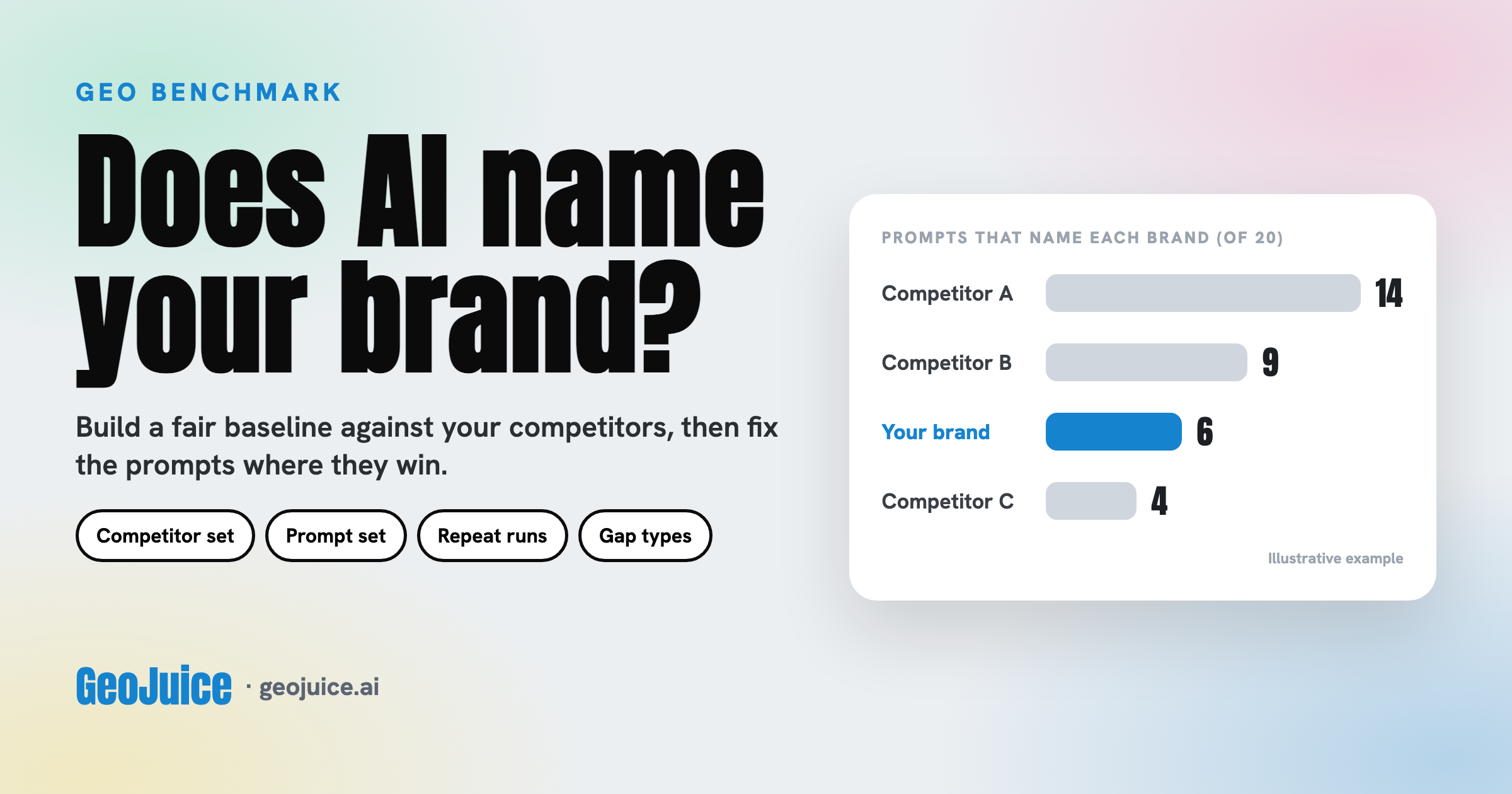
To benchmark whether AI names your brand, pick three to five competitors, write 20 to 30 buyer prompts, and run each prompt several times in ChatGPT, Perplexity, and Google AI Overviews. Score every answer as cited with a link, named, or absent, then compare your totals with each competitor's. The result is a baseline you can repeat. It shows where you stand today and which prompts to fix first.
What is an AI benchmark, and how is it different from tracking?
Generative engine optimization (GEO) is the work of getting AI answer engines to name and cite your site. A benchmark is a one-time snapshot of how often they do, compared with your competitors. Tracking is what you do afterward: repeat the same checks every month and watch the trend. You need the snapshot first, because a trend with no starting point tells you nothing. For the monthly routine, read how to measure GEO without traffic data.
Before you spend an hour on prompts, run the free GeoJuice audit. If AI crawlers cannot reach your site, engines have to rely on what they learned earlier and on what other sites say about you. You will want to know that before you read the results.
1. Decide how you will score an answer before you collect any
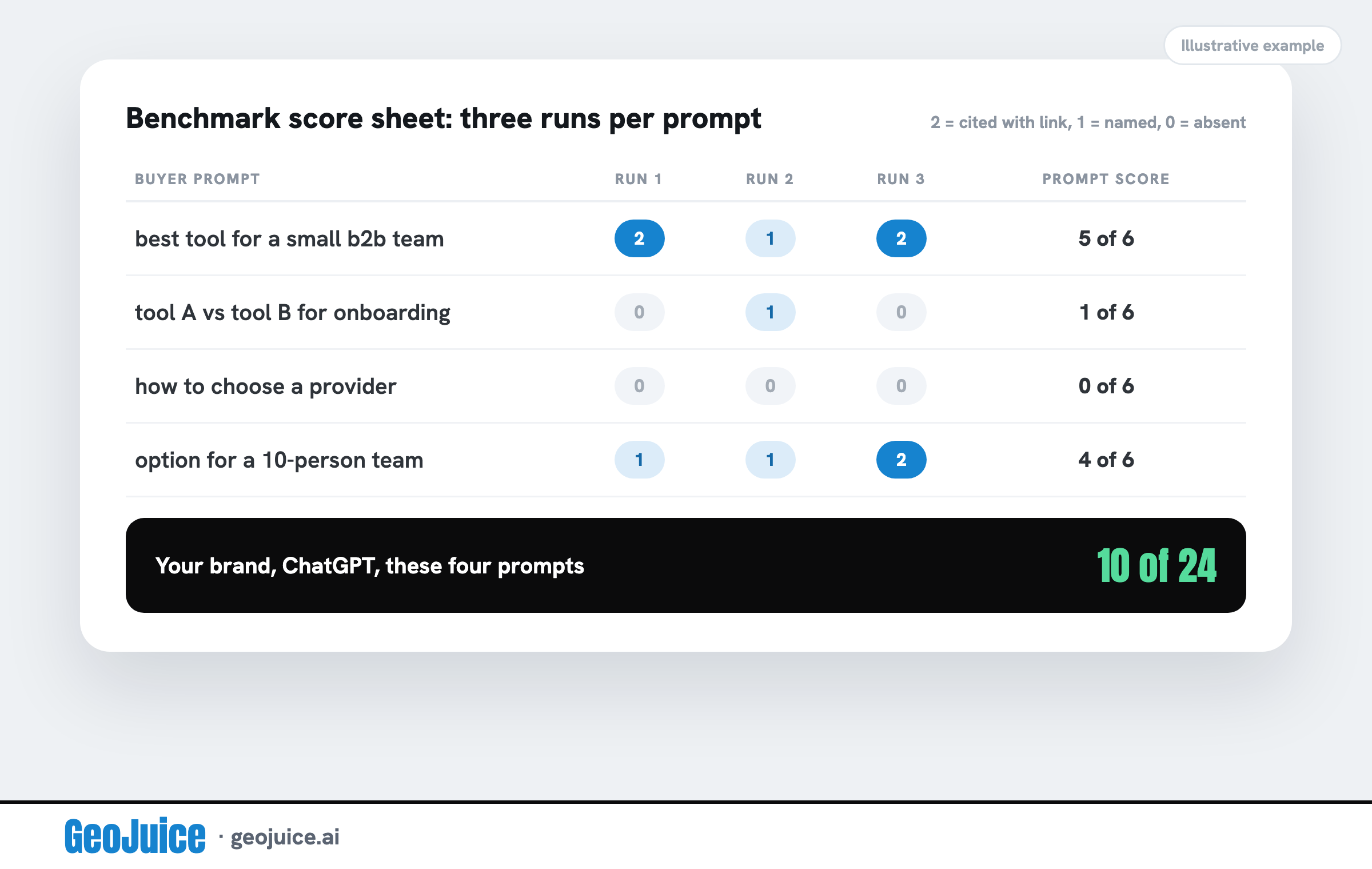
Fix the scale first, so you cannot bend it to fit the results. Give every answer a score: 2 if it cites your page with a link, 1 if it names you without one, and 0 if you are absent. Score every competitor the same way, since the answer text already lists them. Add a second mark for accuracy: is the description of you correct? Being named for the wrong thing is its own kind of gap, and a bare mention does not show that the engine recommends you.
2. Write prompts from four buyer intents
Write 20 to 30 prompts across the four ways buyers ask. Discovery prompts name a need and no brand, such as “best option for a small team.” Comparison prompts set two choices against each other. Problem prompts ask how to fix something your product solves. Constraint prompts add details such as budget, team size, or location. Leave your own name out of all of them, so the answer shows whether AI reaches for you unprompted. Add three or four separate prompts that do name you and score them on their own, since they show what AI says once it knows who you are and would flatter a blended total.
Your competitor list falls out of the same work. Run a few discovery prompts yourself and write down the three to five brands that keep appearing. Add one alternative that is not a direct rival, such as a service instead of a product, because buyers weigh those too. Then freeze the list. If it changes between runs, your numbers stop being comparable.
3. Run every prompt the same way
Use the same engines each time: ChatGPT, Perplexity, and Google AI Overviews are a sensible start. Turn on web search where the app offers it, since that is the mode that cites pages. Use a fresh or logged-out session when you can, so your own chat history does not shape the answer. Run each prompt three times, because answers change from run to run, and save the full text. Do all the runs within a day or two so the engines are working from the same version of the web.
For every run, log five details: the date, the engine, the model if the app shows one, your location, and whether web search was on. With those five, anyone can repeat the setup next quarter, including you.
4. Add up the scores and compare like with like
Three runs make six points available per prompt, so you can total each prompt and each engine. Your gap to the leader on each engine is the number to remember, because it shows how far you have to go.
Share of voice adds a second view: your mentions divided by all brand mentions across the same answers. Note whether you were named first or after others, since order matters to a buyer reading a short list.
Write the size of the test beside every result, such as “27 of 90 answers,” because a bare rate hides how small the sample was. Report each engine and each prompt type on its own, since one overall average can hide a weak spot.
5. Use the pattern of misses to see why AI skips you
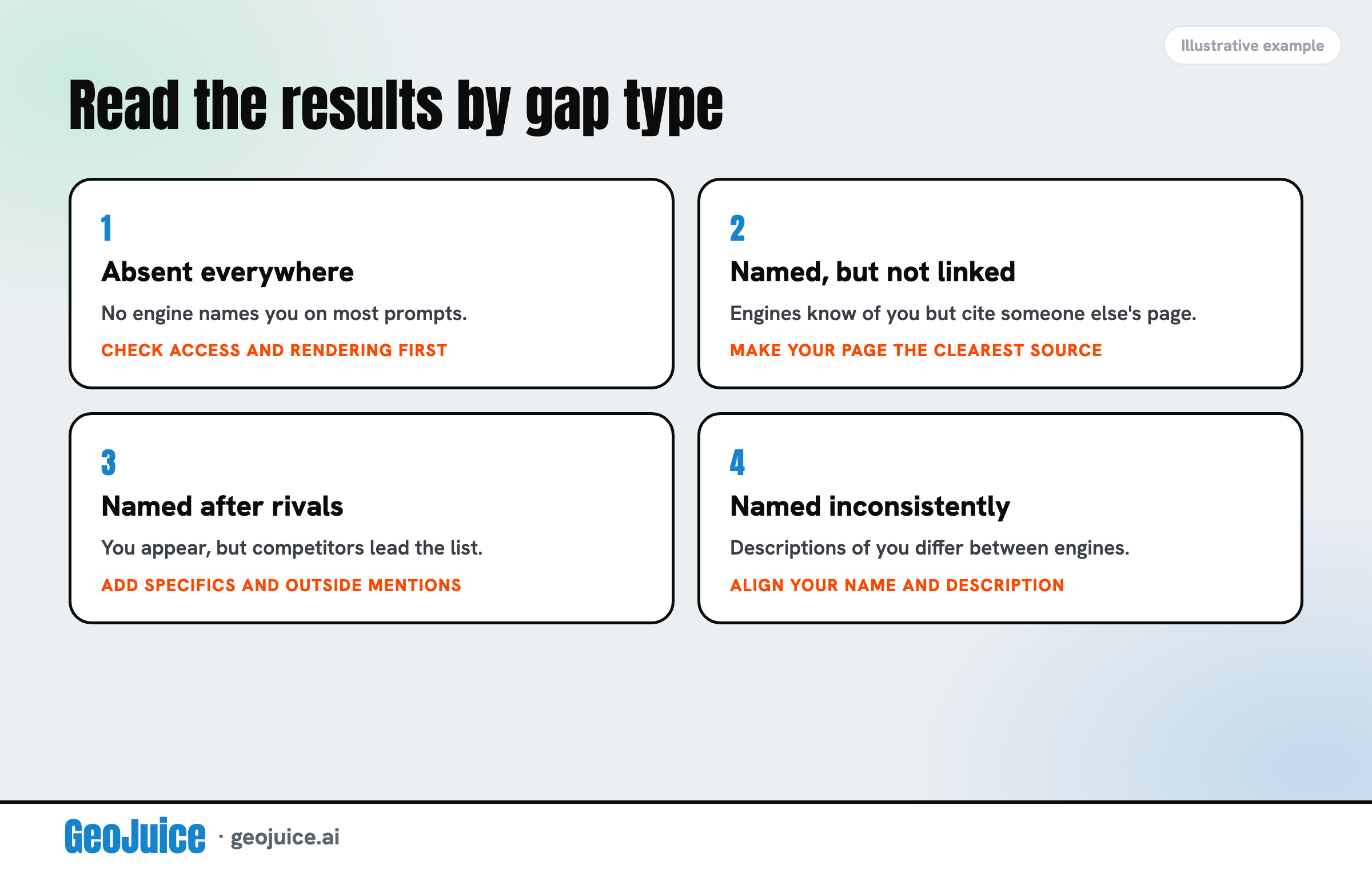
The totals tell you how far behind you are. The pattern tells you why, and four patterns cover most results. If you are absent almost everywhere, check access and rendering first: whether the search crawlers OAI-SearchBot, Claude-SearchBot, and PerplexityBot, and the training crawlers GPTBot and ClaudeBot, are allowed in, and whether your text appears without running JavaScript. If you are named but never linked, engines know of you but prefer another source, so make your own page the clearest answer. If you are named after rivals, you need stronger specifics and outside mentions. If engines describe you wrongly or differently from one another, your name and description are inconsistent across the web, and the fix lives at the sources they cite, not in the answer.
Put your GEO score beside the benchmark to see whether your site or the wider web is holding you back
They answer different questions. The benchmark counts outcomes: how often AI names you. The GEO score measures readiness: whether your site is set up to be cited. Your free GeoJuice scan grades your own site on the 0 to 100 GEO Index across six signals, in about 30 seconds, with no email needed to see it. It does not count citations. Put the two side by side. A low benchmark with a low score points to your site. A low benchmark with a high score points to the web beyond your site, like third-party mentions and consistent entity information. Entity information means the same name and description wherever you are listed.
After the benchmark: fix one gap, then re-run
Pick one gap type and the five prompts that cost you most. Fix those, then wait until engines have had time to re-crawl your pages, which usually takes weeks rather than days. Re-run the identical prompt set and compare it with your first score sheet. Nobody can promise that a specific engine will name you on a specific day, so judge the change across all runs, not a single answer.
When should a benchmark go beyond 30 prompts?
Add prompts when one prompt type drives most of your leads, or when you can run every addition exactly as before. Score the new group on its own, so it never shifts your original totals.
What counts as a good mention rate?
There is no universal target, because the answer depends on your category and your prompts. A good result is one that moves against your own first score sheet and closes the gap to a competitor on the same prompts.
Should I benchmark other languages or regions?
Yes, as a separate benchmark. Answers can change with the language of the prompt and the location of the user, so mixing markets in one set blurs the result. Run one set per market and log the location each time.
Can someone handle the benchmark and the fixes for me?
Yes. GeoJuice also offers done-for-you GEO, which carries out the fixes the scan points to. Re-scan after each fix to see how your GEO score changes, and re-run your prompt set to see whether the naming changes.
How long does a first benchmark take?
Plan a focused half day. Twenty prompts on three engines, three runs each, is 180 answers to run and log by hand. Do the runs in one sitting so the setup stays consistent, then total the scores and read your gap types.
Steven Arevalo · Founder of GeoJuice
Steven is the founder of GeoJuice, the free GEO audit that shows how ready a website is to be cited by AI answer engines. An AI strategist at Lustra Labs, Steven previously consulted for Google Cloud, Waymo and Twitter, and founded Obituare.com, acquired in 2023.
Get new GEO guides by email.
One short email when a new guide is published. Unsubscribe any time.
Does your site have the juice?
Run a free audit and see your GEO Index in 30 seconds.
Get your GEO score