
How do you measure GEO without traffic data?
By Steven Arevalo5 min read
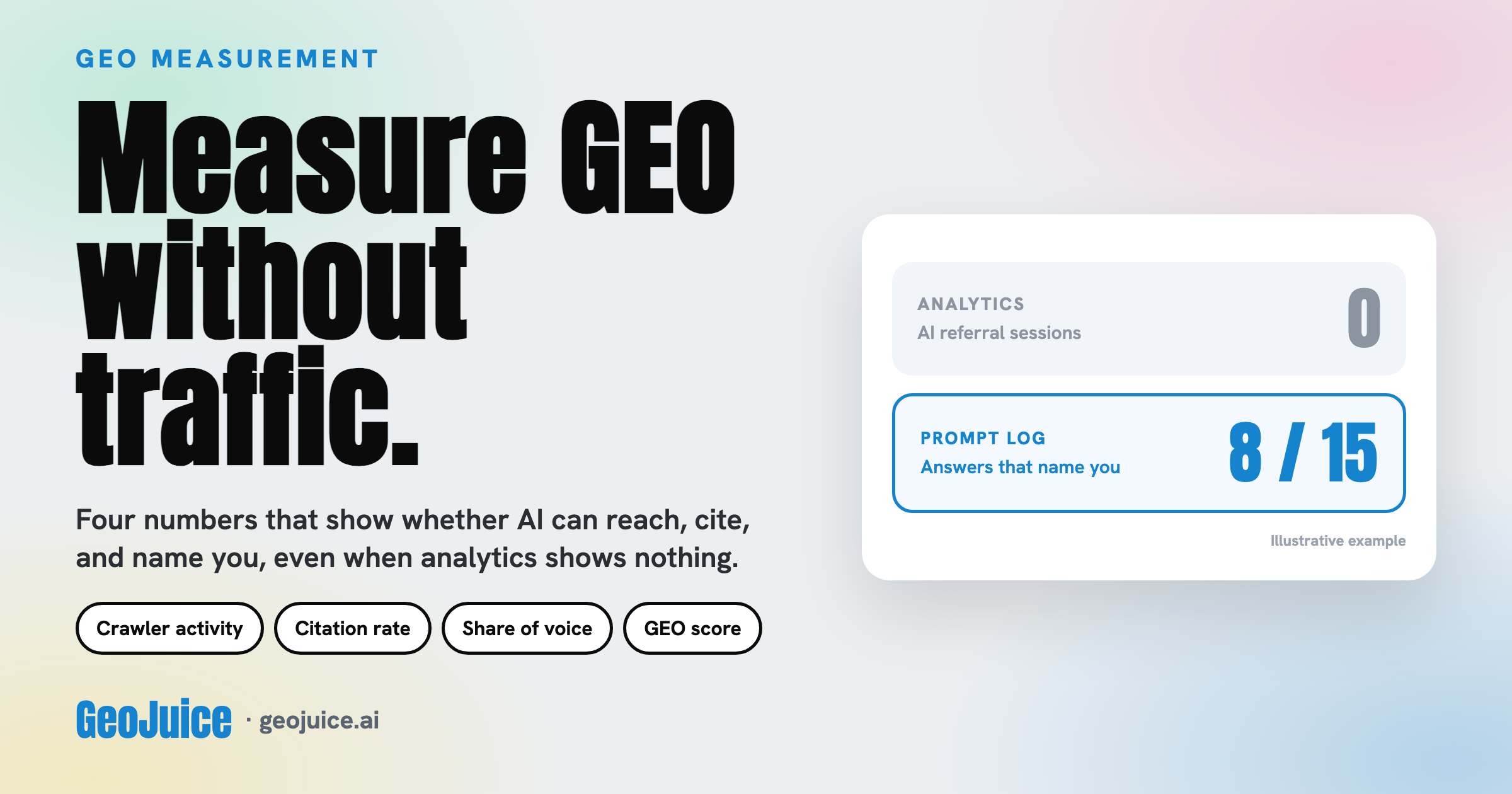
To measure generative engine optimization (GEO) without traffic data, track four things instead of clicks: whether AI crawlers can reach your site, how often AI answers name you for a fixed set of buyer prompts, your share of those answers against competitors, and your GEO score, a 0 to 100 readiness grade. Traffic counts only the visit after a citation. These four check whether AI can reach and cite you, and whether it does.
Why traffic undercounts your GEO results
Generative engine optimization (GEO) is the work of getting AI answer engines to cite your site. Its results are hard to see in analytics, because AI answers resolve the question inside the answer. A buyer asks, gets a short list of names, and often never clicks. When they do click, the visit may arrive tagged as direct, or carry a chatgpt.com or perplexity.ai referrer, depending on the app and the browser. Analytics sees a slice of what happened: the clicks that survive, not the mentions that did the persuading. Flat traffic does not mean GEO is failing, and rising traffic does not prove it is working. You need numbers measured at the citation, not after it.
Set a GEO score baseline before you track anything else
Before you track anything, find out whether your site is eligible to be cited. If GEO is new to you, start with what GEO is. Then run your site through a free GeoJuice audit. You get a GEO score on the 0 to 100 GEO Index. It is graded across six signals: crawler access, structured data (schema code that tells machines what a page is about), on-page content, technical health, content rendering, and llms.txt (a plain-text file that points AI tools to your key pages).
Be clear about what this number is. It measures how ready your site is to be cited, not how many citations you have. That makes it a useful baseline: it tracks what is on your site, so a change in the score usually points to something you or your host changed, such as a new bot rule at your CDN.
Track crawler activity, citation rate, share of voice, and GEO score instead of traffic
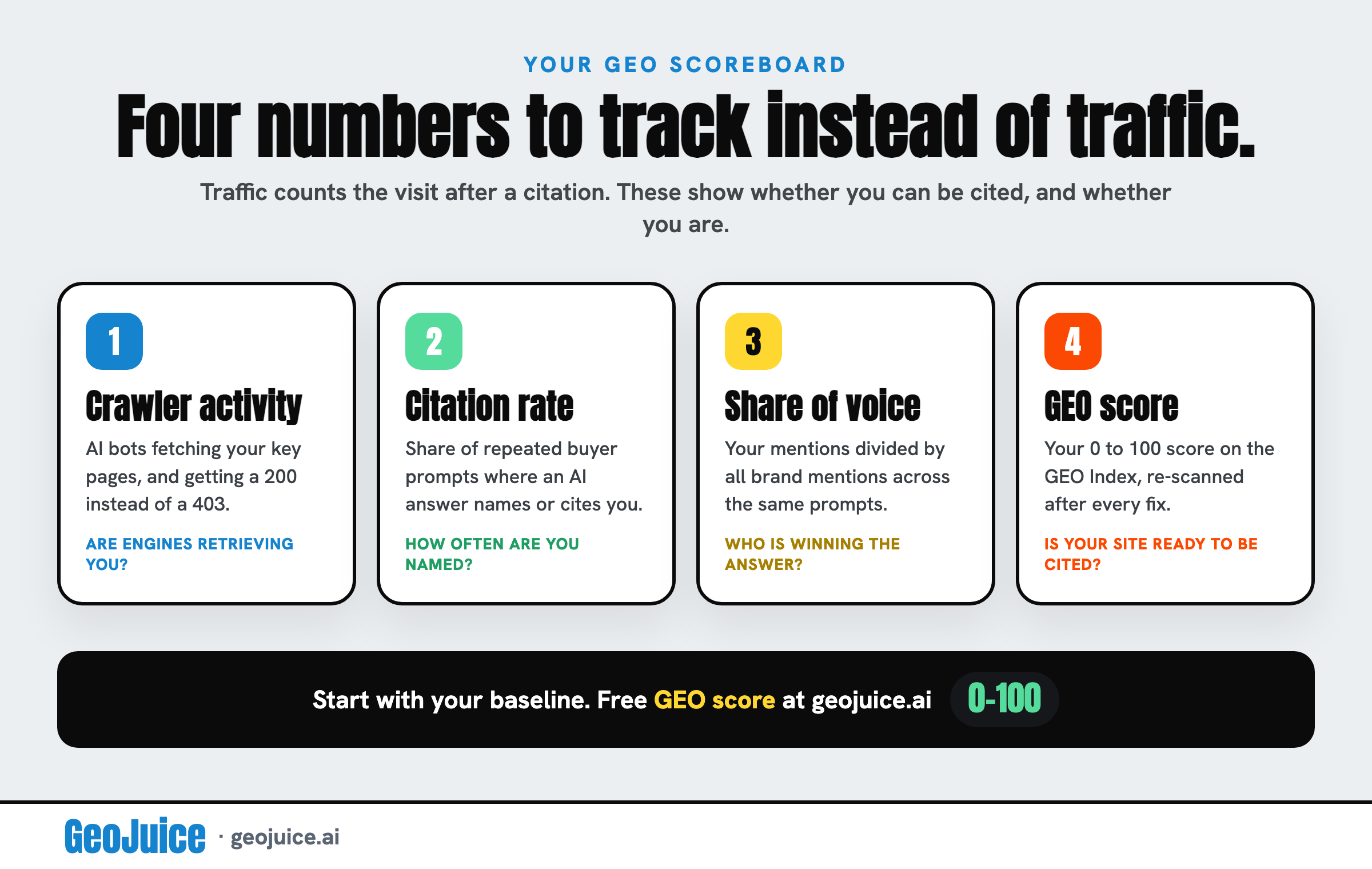
Each number answers a different question, and together they cover the whole path from being fetched to being named. Track all four in one sheet and review it monthly.
1. Crawler activity: are engines retrieving you?
Your server logs or your CDN’s analytics (the network that serves your site, such as Cloudflare) show which bots visit and what your site answered. Count fetches from the bots that retrieve pages for answers: OAI-SearchBot and ChatGPT-User from OpenAI, Claude-SearchBot and Claude-User from Anthropic, and PerplexityBot and Perplexity-User. GPTBot and ClaudeBot are training crawlers, so their visits show eligibility for training, not retrieval for answers. Check the status codes too. A steady stream of 200s means engines can read you, while a wall of 403s means a firewall or bot rule is turning them away. Bot names change, so check each vendor’s current crawler documentation. Treat this as a leading indicator, not proof of citation.
2. Citation rate: how often are you named?
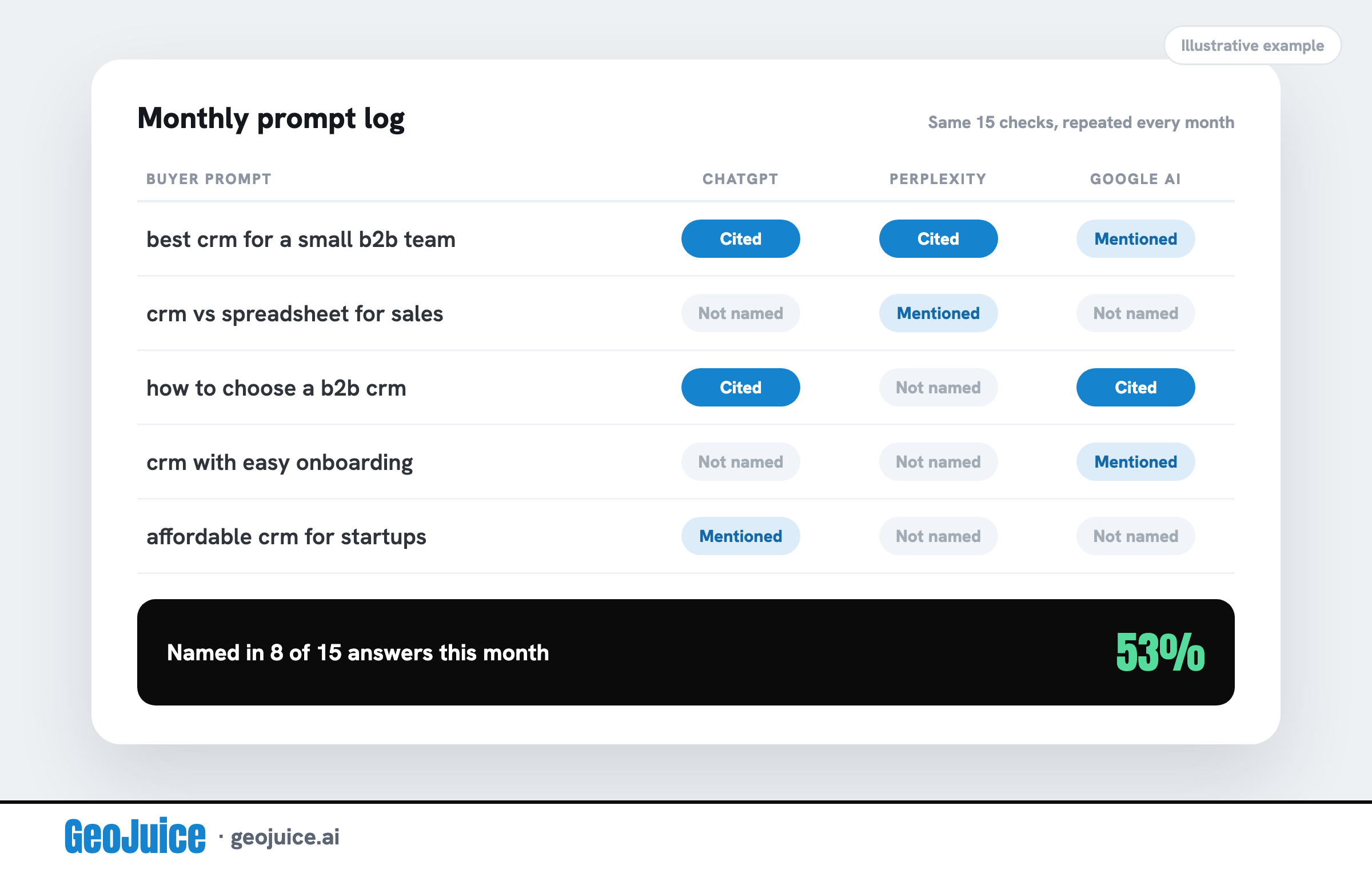
Write 20 to 30 prompts your buyers actually ask: the best option for a use case, a comparison between two choices, how to pick a provider. Run each one in ChatGPT, Perplexity, and Google AI Overviews, and log whether you were cited with a link, mentioned by name, or not named at all. Answers change from run to run, so repeat each prompt a few times and record the share of runs where you appear, not a single yes or no. Keep the wording identical every month so the numbers stay comparable.
3. Share of voice: who is winning the answer?
In the same log, write down every brand each answer names. Your share of voice is your mentions divided by all brand mentions across the prompt set. This catches the case your citation rate hides: your numbers hold steady while a competitor quietly takes a bigger share of the answers. It also shows you which prompts to work on first, because the gaps are written down.
4. GEO score: is your site ready to be cited?
Re-scan after every meaningful fix and plot the GEO score next to your citation rate. If the score climbs and the citation rate follows within a few weeks, the fix worked. If the score is high and the citation rate stays flat, the gap is probably off-site: third-party mentions, reviews, and consistent entity information, meaning the same name, address, and description wherever you are listed. The two numbers together tell you which half of the problem you are solving.
Use referrals, branded search, and forms as supporting evidence
A few traditional signals still help. Add an “AI assistant” option to the “how did you hear about us” question on forms and in sales calls. Watch branded search impressions in Search Console, since people often look you up after an AI answer names you. Check analytics for AI referrers, and treat them as an undercount that backs up the scoreboard, never as the scoreboard itself.
A monthly GEO tracking routine you can keep
Build your prompt set once. Then each month, re-scan your site and record the GEO score. Check crawler activity and status codes in your logs. Re-run the prompt set and update the citation rate and share of voice. Pick the one gap with the biggest cost and fix it. Measure again next month. The scan covers the GEO score row of your sheet; the log and prompt rows are yours to fill. The routine matters more than the tooling, because a number you check once is a snapshot and a number you check monthly is a trend.
How do I set up AI referral tracking in Google Analytics?
Create a custom channel group or an exploration segment whose session source matches a pattern such as chatgpt.com|perplexity.ai|copilot.microsoft.com. Keep that list in a note and review it every few months, because AI products change domains. Name the segment clearly and save it, so every month’s numbers use the same definition.
Should I use a paid citation tracker or a spreadsheet?
Start with a spreadsheet. Twenty to thirty prompts across three engines is quick to run by hand each month. A paid tool can automate repeat runs and add competitor tracking, which helps once you track many prompts. Before you pay, check that the tool lets you export the raw answers, so you can audit its counts.
How long after a fix should I expect citations to change?
Crawler fixes can show up within days to a few weeks, once engines re-crawl your pages, while off-site changes take longer. Keep running the same prompts so you can see the trend. Nobody can promise that a specific engine will name you on a specific day, and anyone who does is guessing.
What is a good citation rate?
It depends on your category and on the prompts you choose, so there is no universal target. Compare yourself with your own numbers from earlier months and with competitors on the same prompts. Movement in the right direction matters more than any single figure.
Can someone handle the GEO fixes and tracking for me?
Yes. GeoJuice also offers done-for-you GEO, which carries out the fixes the scan ranks. Ask for a before-and-after GEO score on every fix so you can match it against your own prompt log.
Where should I start with GEO?
Get your free GEO score in about 30 seconds, with no email needed to see it, and write it in row one of your tracking sheet.
Steven Arevalo · Founder of GeoJuice
Steven is the founder of GeoJuice, the free GEO audit that shows how ready a website is to be cited by AI answer engines. An AI strategist at Lustra Labs, Steven previously consulted for Google Cloud, Waymo and Twitter, and founded Obituare.com, acquired in 2023.
Get new GEO guides by email.
One short email when a new guide is published. Unsubscribe any time.
Does your site have the juice?
Run a free audit and see your GEO Index in 30 seconds.
Get your GEO score