
What is GEO (Generative Engine Optimization)?
By Steven Arevalo5 min read
Generative Engine Optimization (GEO) is the practice of structuring your website so AI answer engines such as ChatGPT, Perplexity, Google AI Overviews, and Gemini can read it, trust it, and cite it in their answers. Where search engine optimization (SEO) earns a ranking in a list of links, GEO earns a mention inside the answer a buyer actually reads.
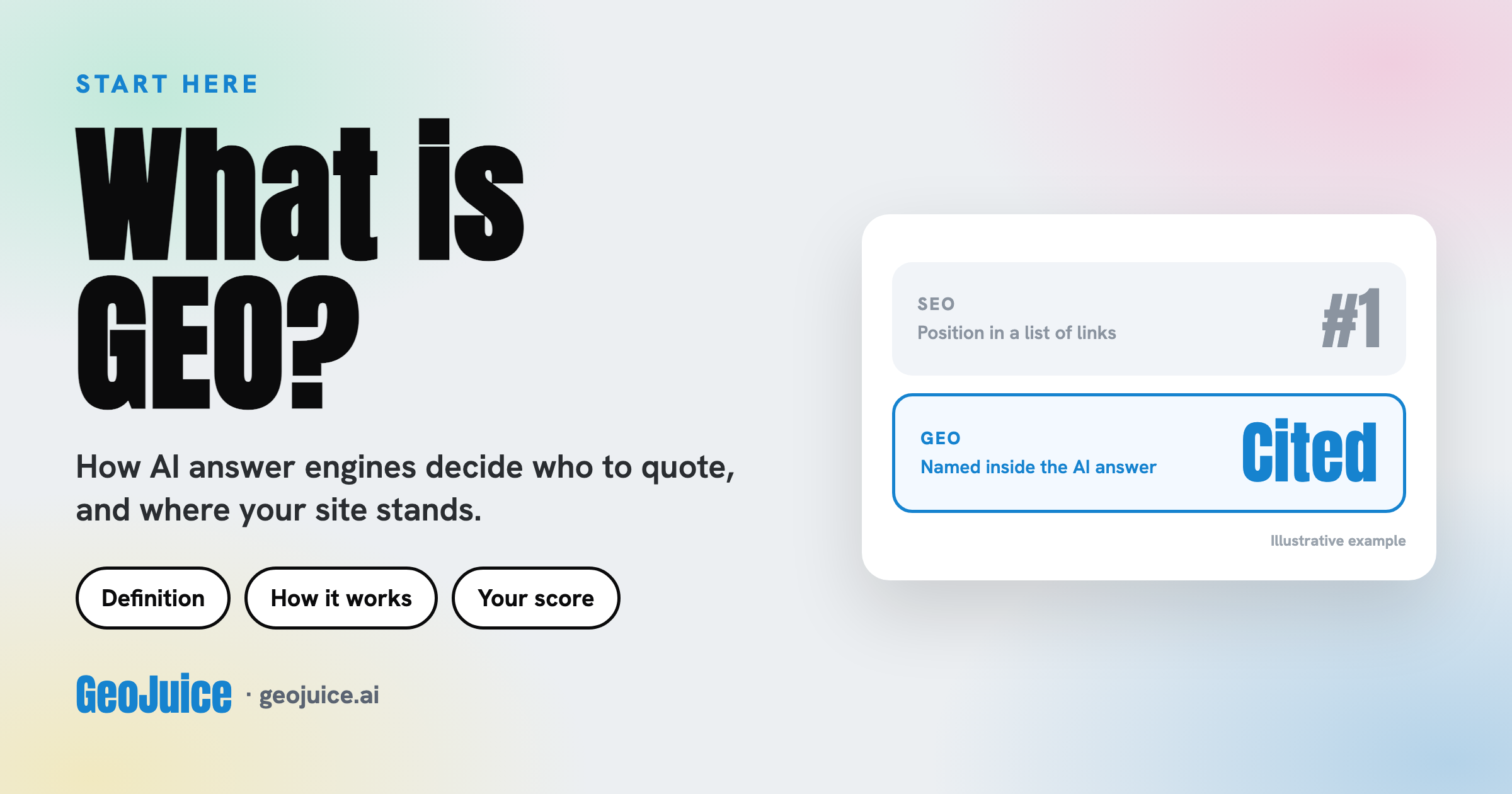
GEO is the work of getting AI answers to name your site
Buyers increasingly start research inside an AI assistant. They ask who the best vendor is for a job, get a short list of names, and act on it, often without ever opening a results page. If your brand is not on that list, you are not in the consideration set. Generative engine optimization, or GEO, is the work of getting onto it.
SEO earns a place in the list; GEO earns a mention in the answer
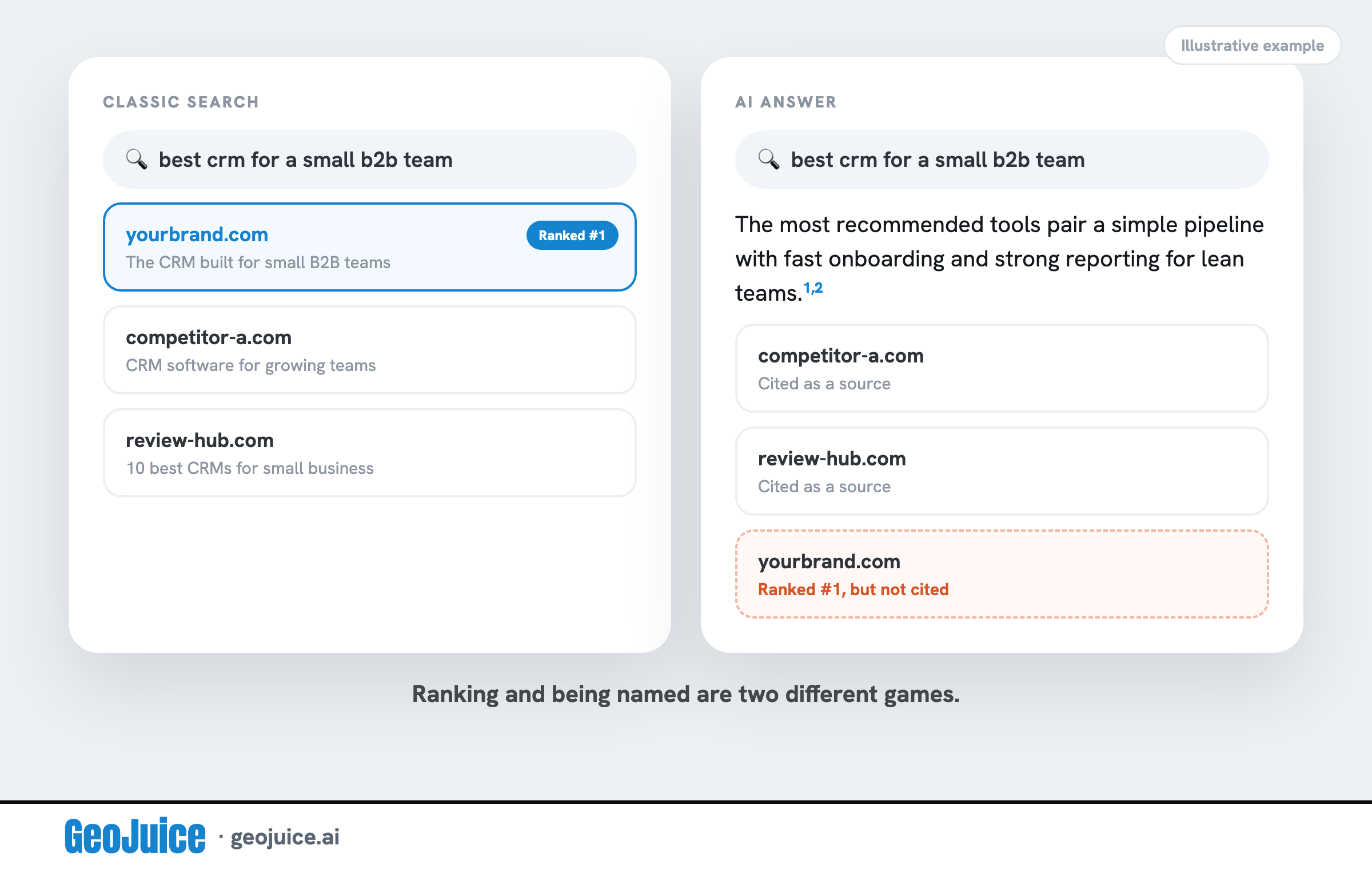
Think of a ranked list as a shelf of brochures the buyer browses. An AI answer works more like a colleague’s recommendation, so a page can rank first and still be left out, as the example below shows.
When engines search the web, they typically retrieve a handful of candidate pages and quote a few of them. Without search, they answer from what they learned in training. Either way, clear, consistent, quotable pages count for more than keyword density.
Crawlable, credible content serves both SEO and GEO, so the two overlap.
Get your GEO score before you change anything
Before the theory, get a number. Run your site through a free GeoJuice audit and you get a GEO score on the 0 to 100 GEO Index. It grades six signals. Crawler access asks whether AI bots can fetch your pages. Structured data is schema markup that labels what a page is. Content rendering asks whether your text appears without running JavaScript. llms.txt is a plain-text file at your site root that tells AI tools which pages matter. The other two signals are on-page content and technical health. You also get a ranked list of fixes. The score measures readiness to be cited, not live citations.
Five fixes decide whether AI names you, cheapest first
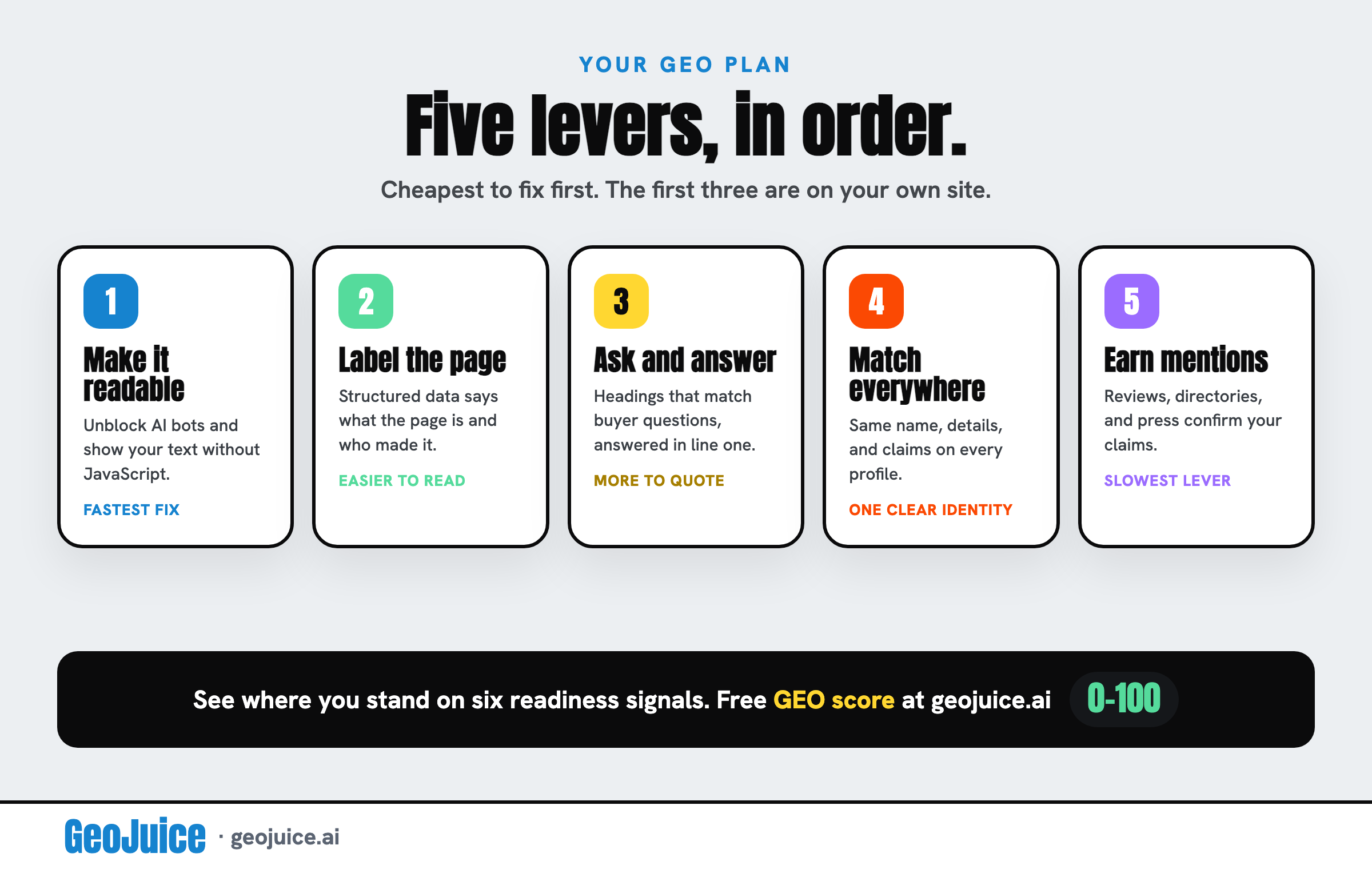
Suppose a buyer asks an AI assistant for the best CRM (customer relationship management software) for a small team. Five things decide whether your CRM page gets named, and they are cheapest to fix in this order.
1. Make sure AI can read the page at all
If a firewall blocks AI bots, most AI engines cannot fetch the page at all. If your text only appears after JavaScript runs, many AI crawlers will see an empty page, though Google’s crawler does render JavaScript. Fix this first because it is fast and it blocks everything after it. Technical fixes can show up within days or weeks as engines re-crawl your pages.
2. Label the page with structured data
Add Organization schema to your homepage and Article schema to your posts. A local business should also add LocalBusiness schema with its address and hours. Do not expect a lift from markup alone: Google says structured data gives no general ranking boost, and a thin page with perfect markup still loses to a thorough page without it. Its job is narrower: it makes the byline, the company behind the page, and the page type machine-readable, so an engine does not have to piece them together from the layout.
3. Write headings as the questions buyers ask
A buyer rarely stops at one question. A page that also covers the price, setup, and comparison questions that come next gives a model more to quote. Put the answer in the first sentence under each question, so a single line can be lifted and still make sense.
4. Keep your facts identical everywhere
Pick one company name, one-line description, and address, and use them word for word everywhere you are listed. When an engine finds two versions of your details, it may trust a source that tells one story.
5. Earn mentions on sources engines already trust
Reviews, directories, and press confirm what you say about yourself. This is the slowest lever, and the scan cannot grade it, because it happens outside your site.
GEO improves your odds but cannot guarantee a citation
GEO improves the conditions for being cited. It does not guarantee a specific engine will name you on a specific day, and anyone who promises that is guessing.
Engines also disagree with each other: each uses its own index, retrieval method, and model, so the same page can be named by one and skipped by another.
Four GEO fixes you can make today
1. Open yoursite.com/robots.txt (the file that tells bots which pages they may crawl) and confirm OAI-SearchBot, PerplexityBot, and Claude-SearchBot are not disallowed, then ask your host whether the firewall blocks them. Confirm current names in each vendor’s crawler documentation. 2. Check your homepage with a structured data validator and add any missing Organization markup. 3. Copy your one-line description from your homepage into LinkedIn and your top two directories. 4. Pick your three highest-traffic pages and rename one heading on each to a buyer question.
Is GEO the same as AEO or AI SEO?
Mostly, yes. Generative Engine Optimization, answer engine optimization, and AI SEO all describe the same goal: getting AI systems to retrieve, trust, and cite your content. GEO is the term we use.
Do I need an llms.txt file?
It is a small bonus, not a fix. The major engines have not confirmed that they rely on it. It is cheap to add and it is one of the six signals the scan grades, but it will not rescue a blocked crawler.
Can I check what ChatGPT says about my brand myself?
Yes. Write ten questions a buyer would ask, run each in ChatGPT, Perplexity, and Google AI Overviews, and note which brands are named. Repeat monthly with the same wording. Here is the full method for measuring GEO without traffic data.
Does GEO work for any kind of business?
The signals apply to any website, but what earns a citation differs by industry and by the questions your buyers ask. A dentist and a software company get cited for different reasons, so tune your content to the prompts your own buyers use.
Can someone make these GEO fixes for me?
Yes. The free scan ranks the fixes so you can work through them yourself. If you would rather hand them off, GeoJuice also offers done-for-you GEO, which carries out the fixes for you.
Where should I start with GEO?
Get your free GEO score in about 30 seconds, with no email needed to see it, and fix the top-ranked issue first.
Steven Arevalo · Founder of GeoJuice
Steven is the founder of GeoJuice, the free GEO audit that shows how ready a website is to be cited by AI answer engines. An AI strategist at Lustra Labs, Steven previously consulted for Google Cloud, Waymo and Twitter, and founded Obituare.com, acquired in 2023.
Get new GEO guides by email.
One short email when a new guide is published. Unsubscribe any time.
Does your site have the juice?
Run a free audit and see your GEO Index in 30 seconds.
Get your GEO score