
How to show up in Google AI Overviews, ChatGPT, and Perplexity
By Steven Arevalo5 min read
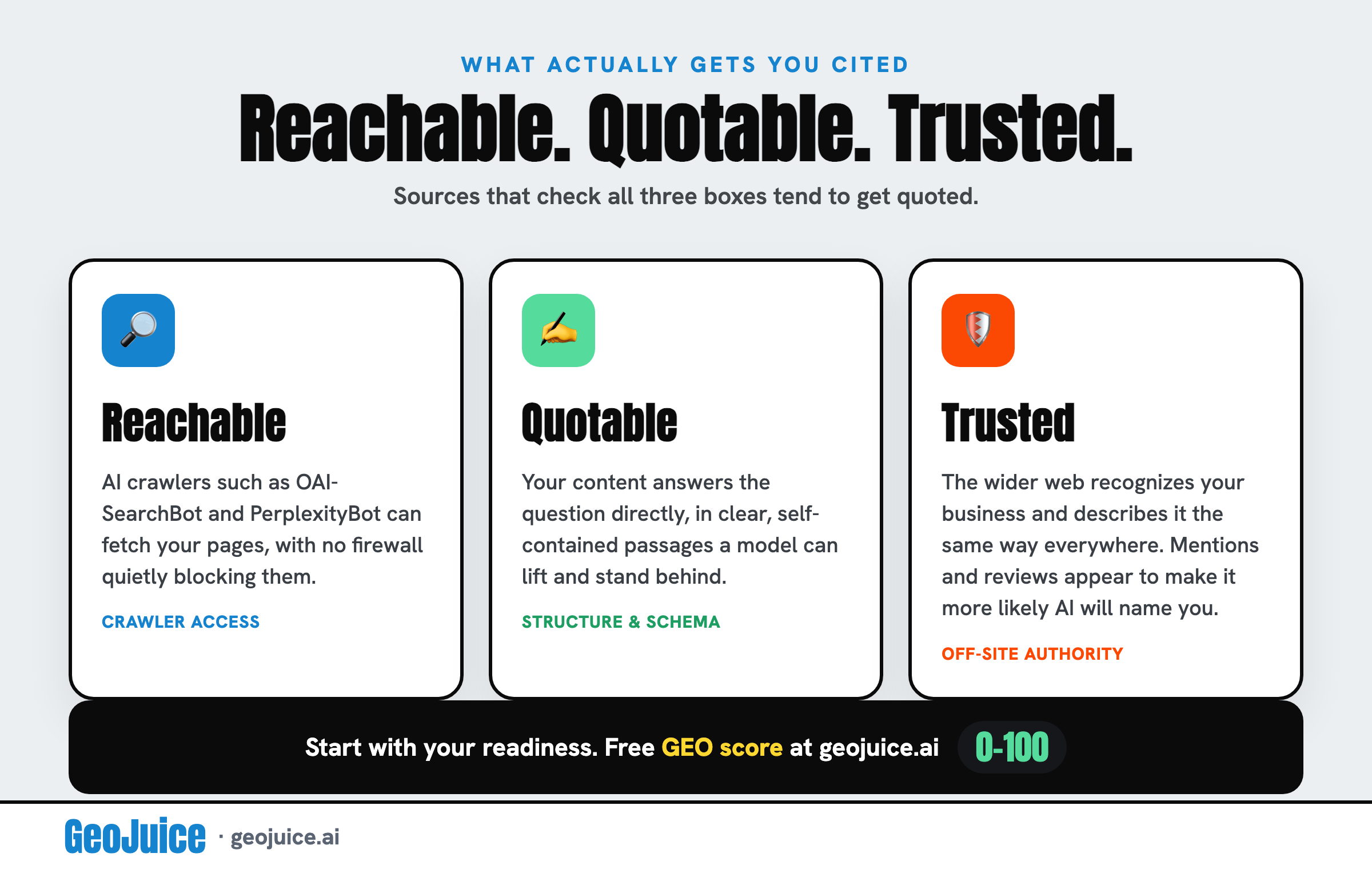
To show up in AI answers from Google AI Overviews, ChatGPT, and Perplexity, three things usually need to be true: AI crawlers can read your site, your content is structured so it is easy to quote, and the wider web recognizes and trusts your business. Weakness in any one of them makes a citation much less likely, even if you rank well.
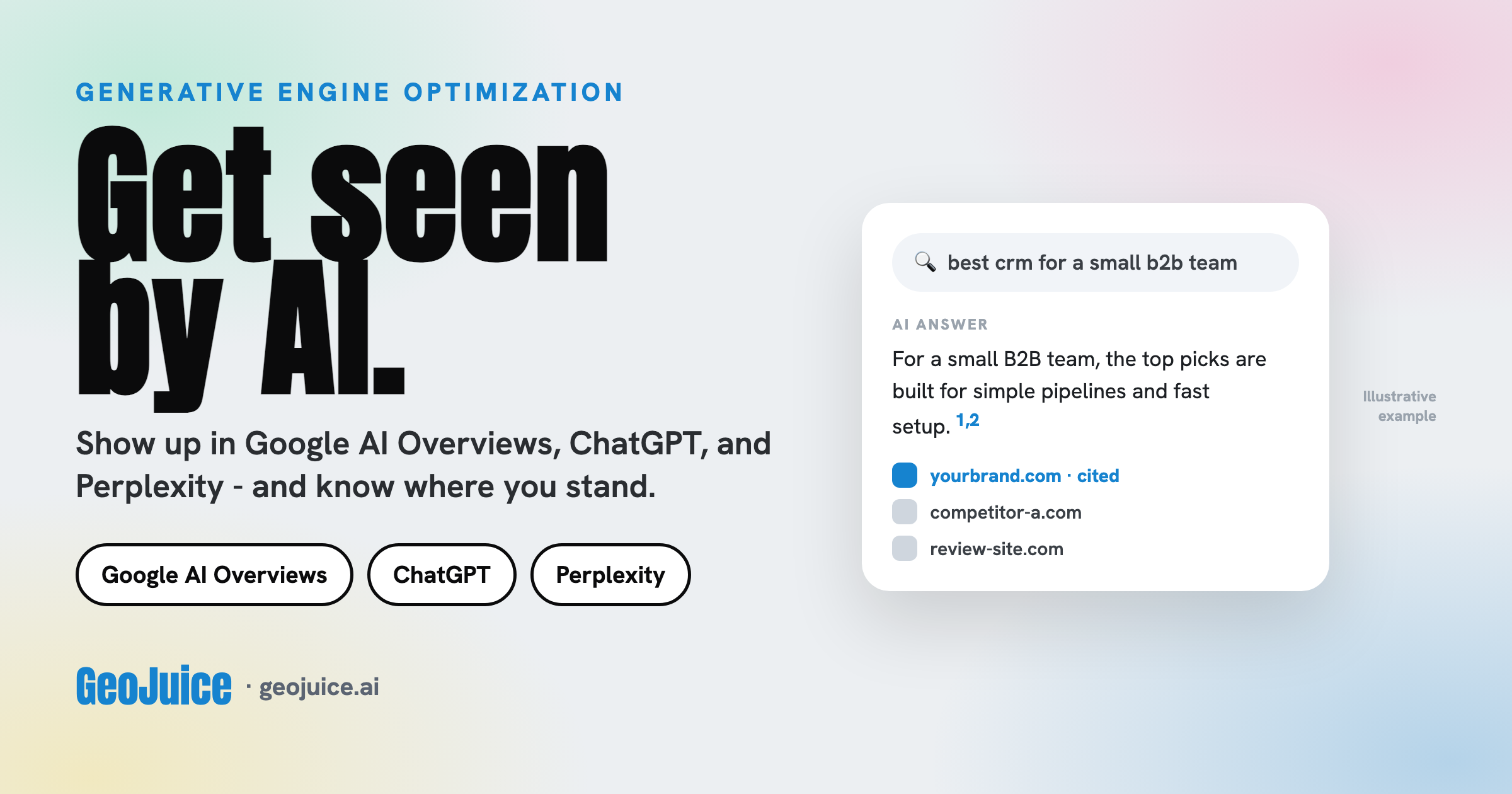
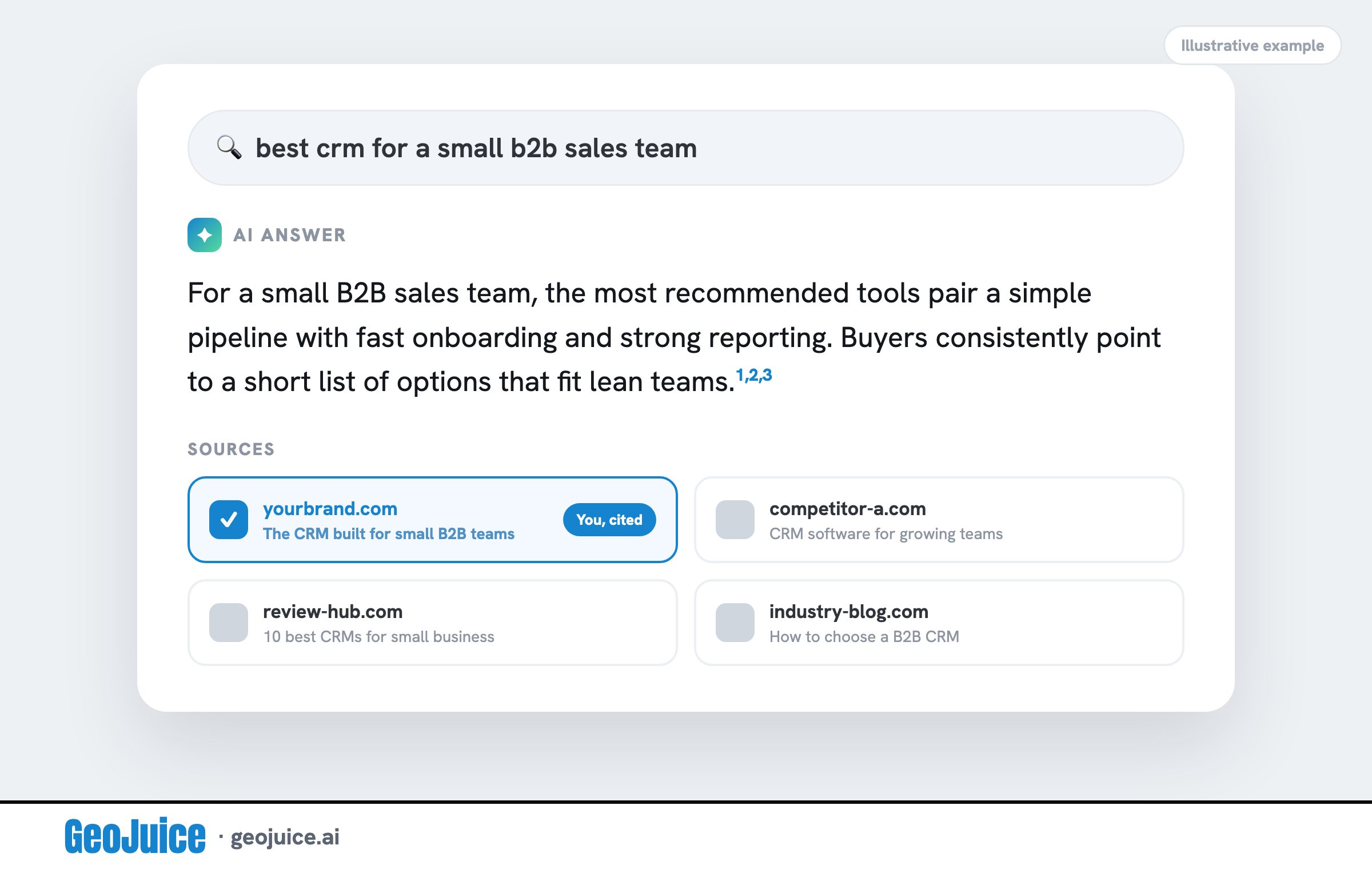
Buyers now get answers before they see links
More people now ask ChatGPT, Perplexity, Google’s AI Overviews, and Copilot instead of scrolling a page of results. These tools answer in one box and credit a handful of sources. If your brand is not one of them, you miss the click, the mention, and the trust that comes with being named. Ranking first and being cited by AI are now two different goals. Working toward the second is Generative Engine Optimization, or GEO. For the full definition, see what GEO is.
First, check whether AI can read your site
Before you change anything, get a baseline. Run your site through the free GeoJuice audit and you get a GEO score, from 0 to 100 on the GEO Index, in about 30 seconds. The scan grades six signals: crawler access, structured data (schema code that labels what a page is), on-page content, technical health, content rendering, and llms.txt (a proposed file that points AI tools to your key pages). It then ranks the fixes by impact. It measures how ready your site is to be cited. It cannot see whether ChatGPT named you today, so treat the score as a readiness check, not a citation count.
How do AI engines pick what to cite?
Each engine works differently, but the pattern is shared. They retrieve a set of candidate pages, then tend to quote the ones that are reachable, clearly on topic, easy to lift a sentence from, and published by a source they trust.
Where each engine looks: Google AI Overviews draw on Google’s search index. ChatGPT search draws on third-party search providers, including Bing. Perplexity retrieves its sources and shows numbered citations that link to each one. Microsoft Copilot draws on Bing’s index.
In practice that comes down to three conditions: reachable, quotable, and trusted.
The GEO playbook: five moves that make a citation more likely
1. Let the AI crawlers in
Start with robots.txt, the file that tells crawlers which pages they may fetch. Then check your CDN (the network that serves your pages) or firewall, which can block a bot even when robots.txt allows it. A common failure looks like this: robots.txt says allow, while Cloudflare or a security plugin quietly returns a 403 (access denied) to the bot. If an engine cannot fetch your page, it cannot quote it, and the moves below cannot help that page.
Know who is knocking. OpenAI’s OAI-SearchBot indexes pages for ChatGPT search, ChatGPT-User fetches a page when someone asks, and GPTBot collects training data. OpenAI says sites that block OAI-SearchBot will not be shown in ChatGPT search answers, though they can still appear as navigational links. Google-Extended is not a crawler at all but a robots.txt control for Google’s Gemini models, and AI Overviews rely on Googlebot. Crawler names change, so check each vendor’s documentation for current bot names, called user agents.
2. Make your business easy for AI engines to identify
An entity is a business or person that engines can identify without confusion. Add Organization schema, the code that tells machines what your business is, with your name, logo, and sameAs links, which tie that schema to your real profiles. Keep your business name and details identical everywhere they appear. Engines appear more likely to cite names they can recognize with confidence, and contradictions across your pages and profiles can give them a reason to choose another source.
3. Structure content so it is easy to quote
Lead each section with the answer, then explain. Write headings as the questions people actually ask, keep paragraphs short and self-contained, add a real FAQ, and state claims plainly enough that a model can lift one sentence and stand behind it. When a model has to guess what you meant, it is more likely to cite a clearer source.
4. Earn third-party mentions
Models weigh what the rest of the web says about you, not only what you say about yourself. Reviews, reputable directories, press, and links from trusted sites appear to raise the odds that your brand is named without being prompted. You cannot create this on your own domain.
5. Keep your pages current
Review your cornerstone pages each quarter, update dates and figures, and remove claims that are out of date. Engines do not publish a freshness rule, but a page with stale dates and outdated figures is a weaker candidate when a current source covers the same question.
Re-scan your GEO score after each fix
Moves 1 and 3, and the on-site schema half of Move 2, map to what the GEO score measures. Keeping your details consistent on outside profiles, Move 4, and Move 5 happen outside the six signals, so track them yourself. Re-scan after each fix and see whether your GEO score moves, and pair it with a fixed set of buyer prompts that you check by hand. Here is how to track those prompts monthly.
Should I block GPTBot but allow OAI-SearchBot?
Yes, that is a valid setup. Blocking GPTBot opts you out of training use without affecting ChatGPT search. Add a separate User-agent block for each bot in robots.txt. ChatGPT-User visits are started by a person, so robots.txt rules may not apply to them.
Does llms.txt help me get cited?
Possibly, but treat it as a small bonus: the major engines have not confirmed that they rely on it. It is cheap to add and it is one of the six signals the scan grades, but it will not fix a blocked crawler.
How long does GEO take to work?
Crawler-access and schema fixes can change what AI sees within days to a few weeks as engines re-crawl your pages. Mentions from other sites take months, because you are waiting on them to publish. Nobody can promise a specific engine will name you on a specific day, so judge progress over months, not days.
Can someone make the GEO fixes on my site for me?
Yes. GeoJuice also offers done-for-you GEO, which carries out the fixes the scan ranks, so you can spend your time on the parts only you can do, such as gathering reviews.
Where should I start with GEO?
Run the free GeoJuice scan, read your GEO score, and fix the top-ranked issue first. It takes about 30 seconds, and you do not need an email to see the result.
Steven Arevalo · Founder of GeoJuice
Steven is the founder of GeoJuice, the free GEO audit that shows how ready a website is to be cited by AI answer engines. An AI strategist at Lustra Labs, Steven previously consulted for Google Cloud, Waymo and Twitter, and founded Obituare.com, acquired in 2023.
Get new GEO guides by email.
One short email when a new guide is published. Unsubscribe any time.
Does your site have the juice?
Run a free audit and see your GEO Index in 30 seconds.
Get your GEO score