
How do you find where competitors beat you in AI answers?
By Steven Arevalo5 min read
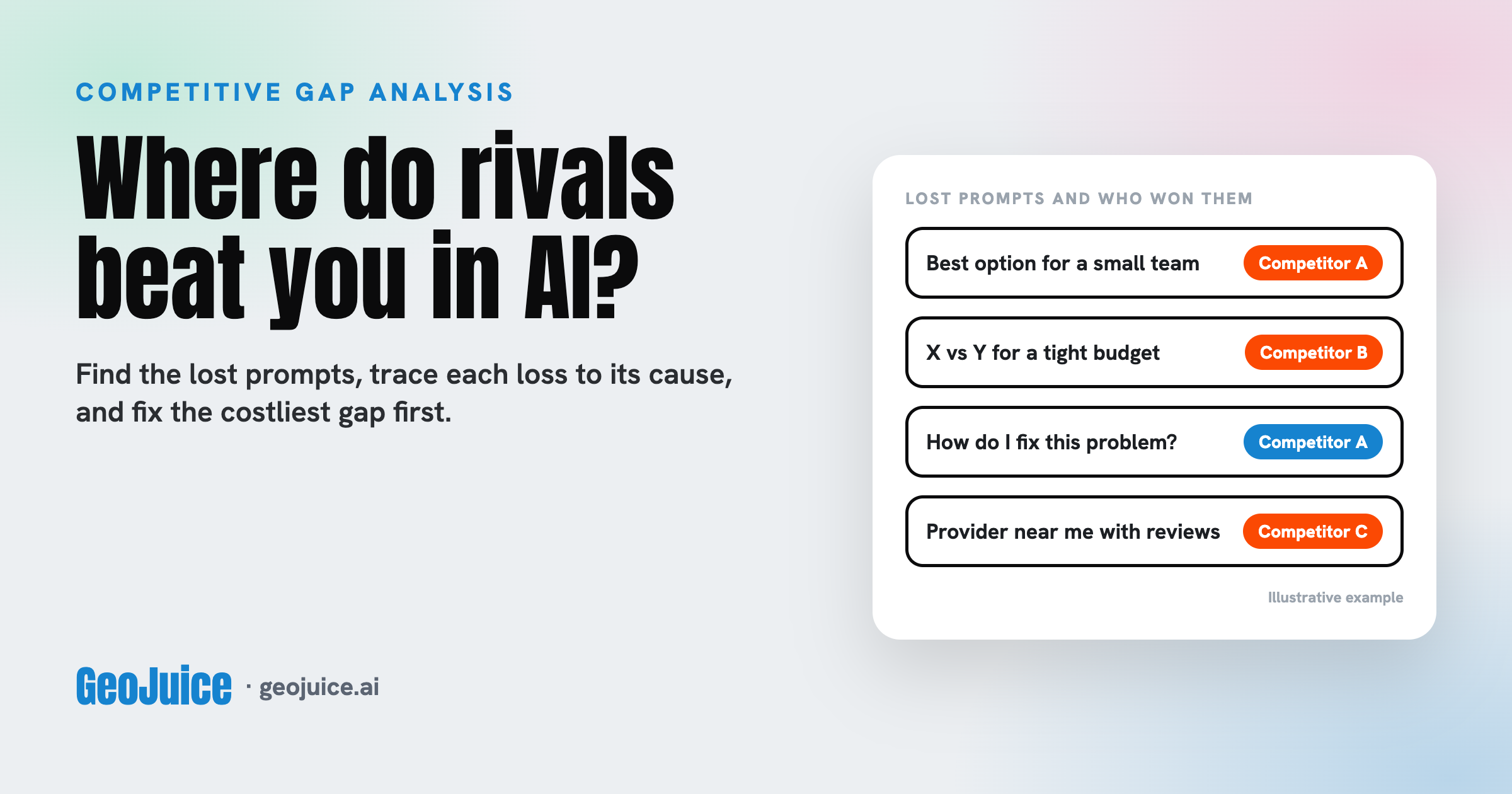
To find where competitors beat you in AI answers, start with the buyer prompts where a rival is named and you are missing or ranked below it. For each loss, log who won, which page the engine cited, and how it described them. Open that page beside yours, then sort the loss into one of four gap types: your site, your page, the wider web, or your description. Fix the costliest type first and re-run the same prompts.
What is a competitive gap analysis for AI answers?
Generative engine optimization (GEO) is the work of getting AI answer engines to name and cite your site. A competitive gap analysis looks only at the prompts you lose: the questions where an engine names a rival and leaves you out. A benchmark counts how often you win and lose. This analysis explains each loss, so you know what to change. If you have not built a prompt set yet, start with how to benchmark whether AI names your brand, then come back.
Before you start, run the free GeoJuice audit on your own site, so you have a GEO score in hand when you reach step 5.
1. Pull the prompts where a rival beats you
Open your benchmark score sheet and filter it to the answers where a competitor appeared and you were either absent or named below them. Those rows are your losses. If you have no sheet yet, write 20 buyer prompts that leave your own name out. Run each in ChatGPT, Perplexity, and Google AI Overviews, turning on web search where the app offers it, and keep the full answers. Ignore the prompts you already win for now, since they cannot show you what is missing.
2. Log what the winner got in each answer
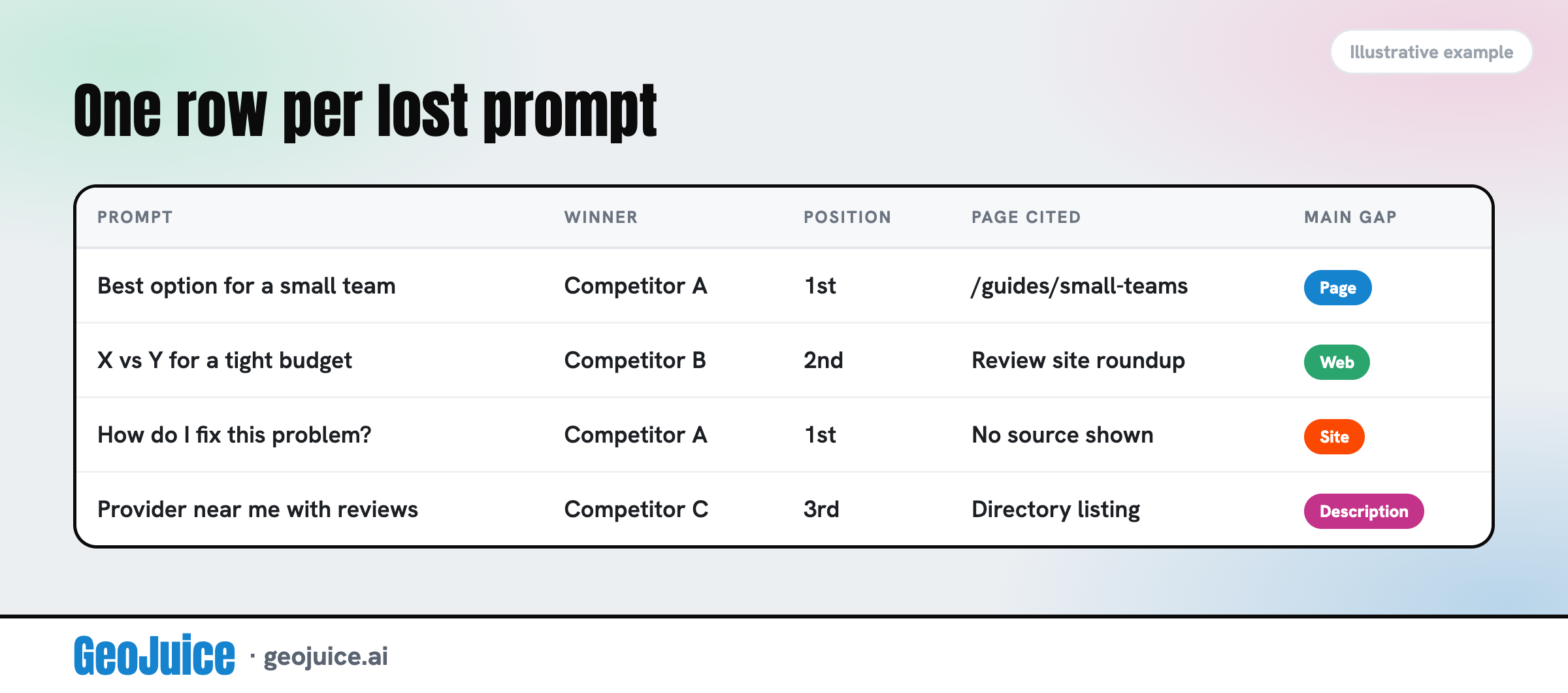
For every lost prompt, record five things: the competitor named, its position in the list, the page the engine cited for it, the words used to describe it, and the engine. The cited page matters most, because it is the evidence the engine chose. Not every engine shows its sources, and some answers cite nothing, so mark those rows as no source and move on.
3. Open the winning page next to yours
For each cited page, find your closest equivalent and compare the two on the same five points. Does the page answer the question in its first lines, under a heading that matches it? Does it give specific facts, such as numbers, dates, names, or steps? Is the company named plainly, with a clear description of what it does? Is there a named author or a visible update date? Can a crawler read the text without running JavaScript? Write yes or no for both pages. A rival page with five yeses against your two is a clear lead on that prompt.
4. Sort every loss into one of four gap types
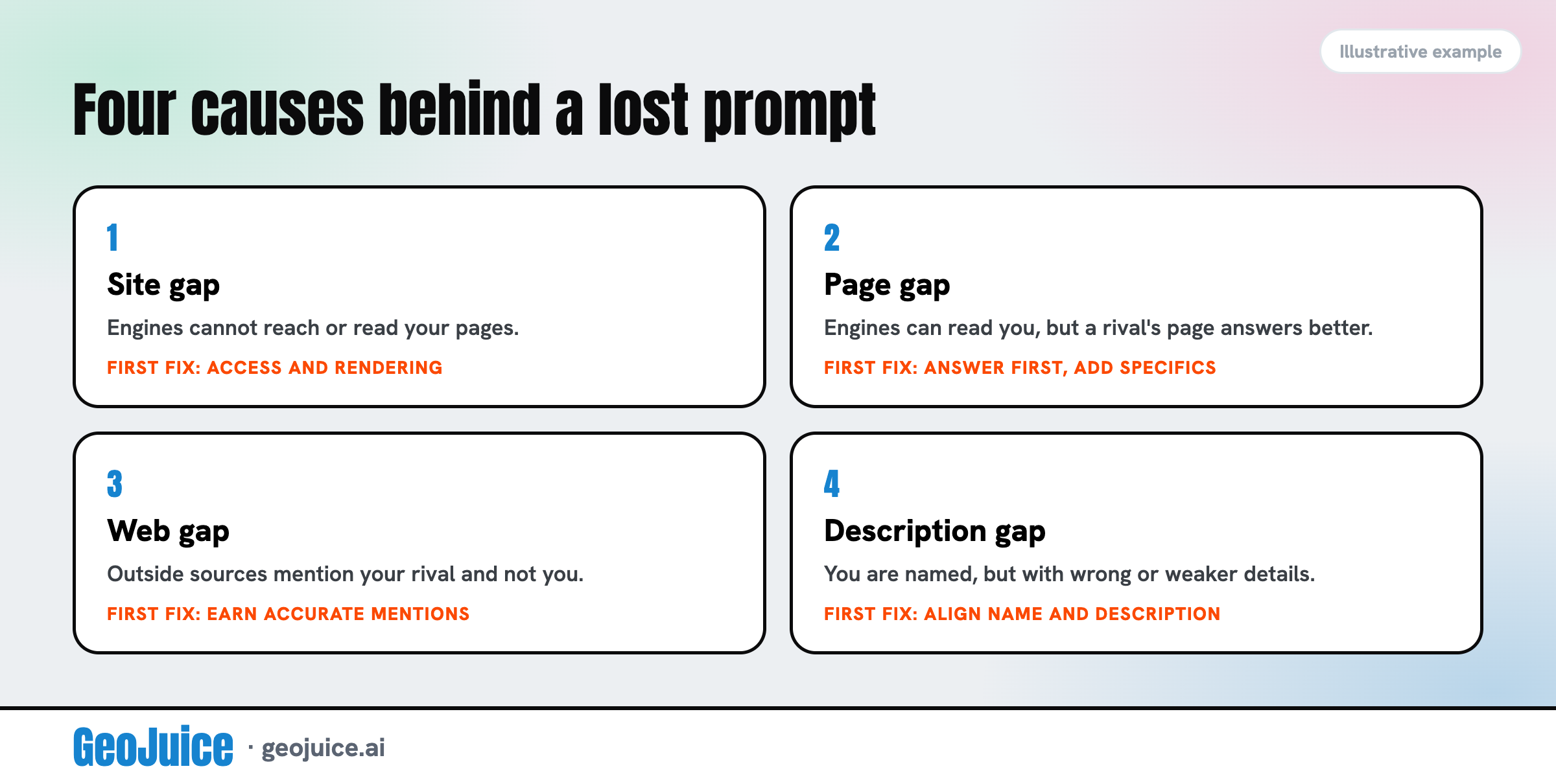
Each loss falls into one of four types, and each type has a different first fix. A site gap means engines cannot reach or read your pages. A page gap means they can, but a rival's page answers the question better. A web gap means the engine leans on outside sources, such as review sites, directories, and articles, that mention your rival and not you. A description gap means you are named, but with wrong details or weaker framing than a competitor. Many losses show more than one type, so label the main one.
5. Scan your site to separate site gaps from the rest
Your free GeoJuice scan grades your site on the 0 to 100 GEO Index across six signals, in about 30 seconds, with no email needed to see it. It measures readiness, not citations. A low GEO score points to site gaps. A score that is solid while a rival still wins points to page, web, or description gaps. Run the same scan on a rival's address for a rough comparison of how ready each site is. The scan cannot see outside sources, so web gaps come from your log, not from a number.
6. Choose the five losses that cost you most, and fix one gap type
Rank your lost prompts by how close they sit to a purchase. A prompt like “best option for a team of ten” matters more than a general definition question. Take the five that matter most and find the main gap type behind them. Fix site gaps first, since nothing else works while engines cannot read you. Page gaps come next, because you control them. Web gaps are slowest, since they depend on other people's sites.
After the analysis: re-run the same prompts and compare
Wait until engines have had time to re-crawl your pages, which usually takes weeks, then re-run the identical prompts and compare the answers with your first log. Answers change from run to run, and nobody can promise that an engine will name you on a given day. Judge movement across the whole set, not a single answer.
How many competitors should I include?
Three to five is enough. Choose the brands that keep appearing in your discovery prompts, add one alternative that is not a direct rival, and freeze the list so your logs stay comparable from one run to the next.
Should I copy the page that won?
No. Use it to learn what the engine found useful, such as a direct answer, specific facts, or a clear description, then write your own page with your own details. Copied text gives readers nothing new and gives engines no reason to prefer you.
What if a rival wins because of other websites?
That is a web gap. Look at which outside pages the engines cite for your rival, such as directories, review sites, or articles, and ask whether your brand belongs there. Earn the mention honestly, with accurate details. Start with the sources that appear in more than one engine's answers, since they cover more ground.
Can someone handle the fixes for me?
Yes. GeoJuice also offers done-for-you GEO, which carries out the fixes the scan points to. Re-scan after each fix to see how your GEO score changes, and re-run your prompts to see whether the naming changes.
How often should I repeat a gap analysis?
Once a quarter suits many teams, and again after a large change to your site. Run it sooner if a new competitor starts appearing in your discovery prompts.
Steven Arevalo · Founder of GeoJuice
Steven is the founder of GeoJuice, the free GEO audit that shows how ready a website is to be cited by AI answer engines. An AI strategist at Lustra Labs, Steven previously consulted for Google Cloud, Waymo and Twitter, and founded Obituare.com, acquired in 2023.
Get new GEO guides by email.
One short email when a new guide is published. Unsubscribe any time.
Does your site have the juice?
Run a free audit and see your GEO Index in 30 seconds.
Get your GEO score