
How do I get cited by ChatGPT?
By Steven Arevalo5 min read
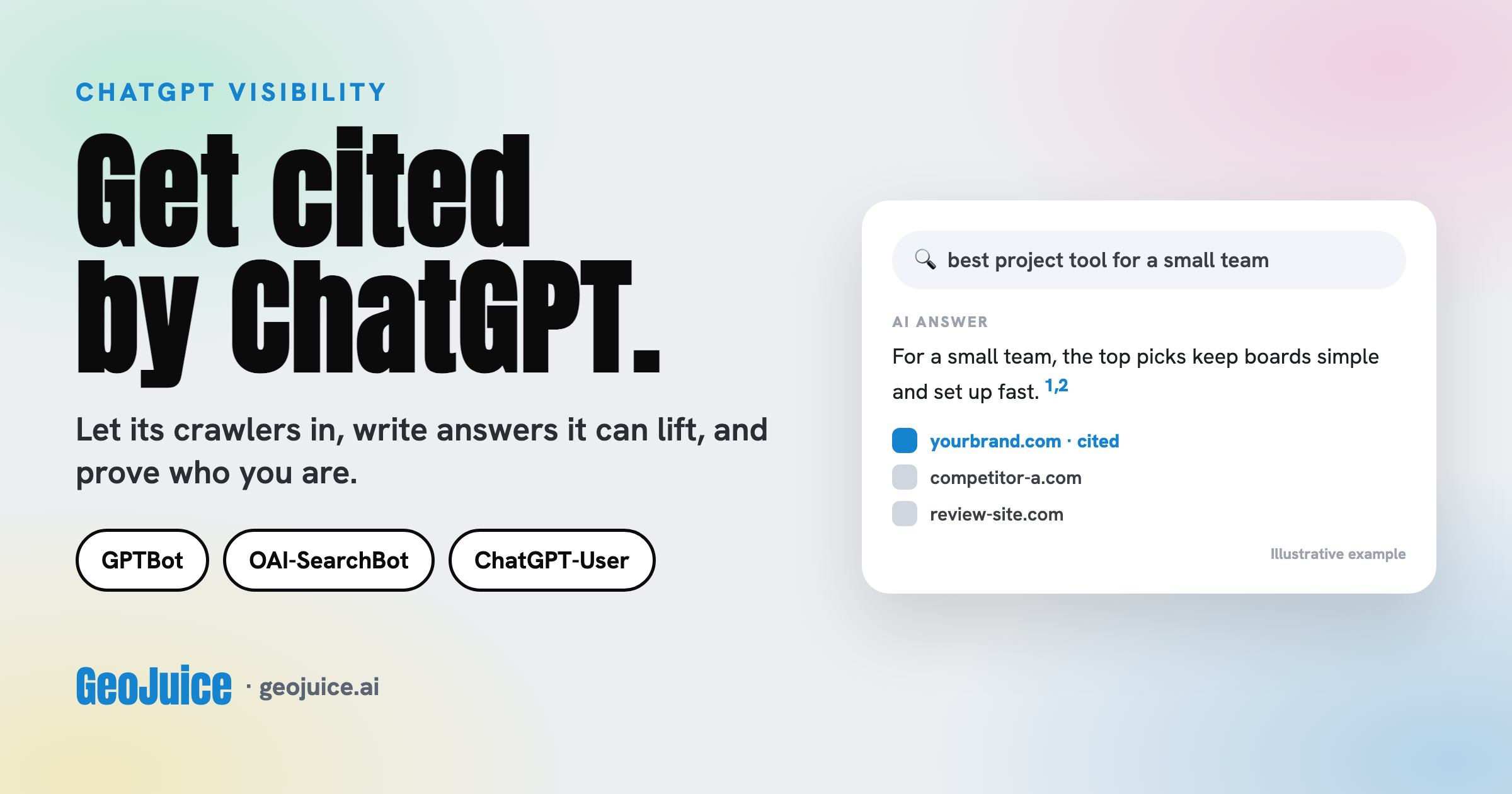
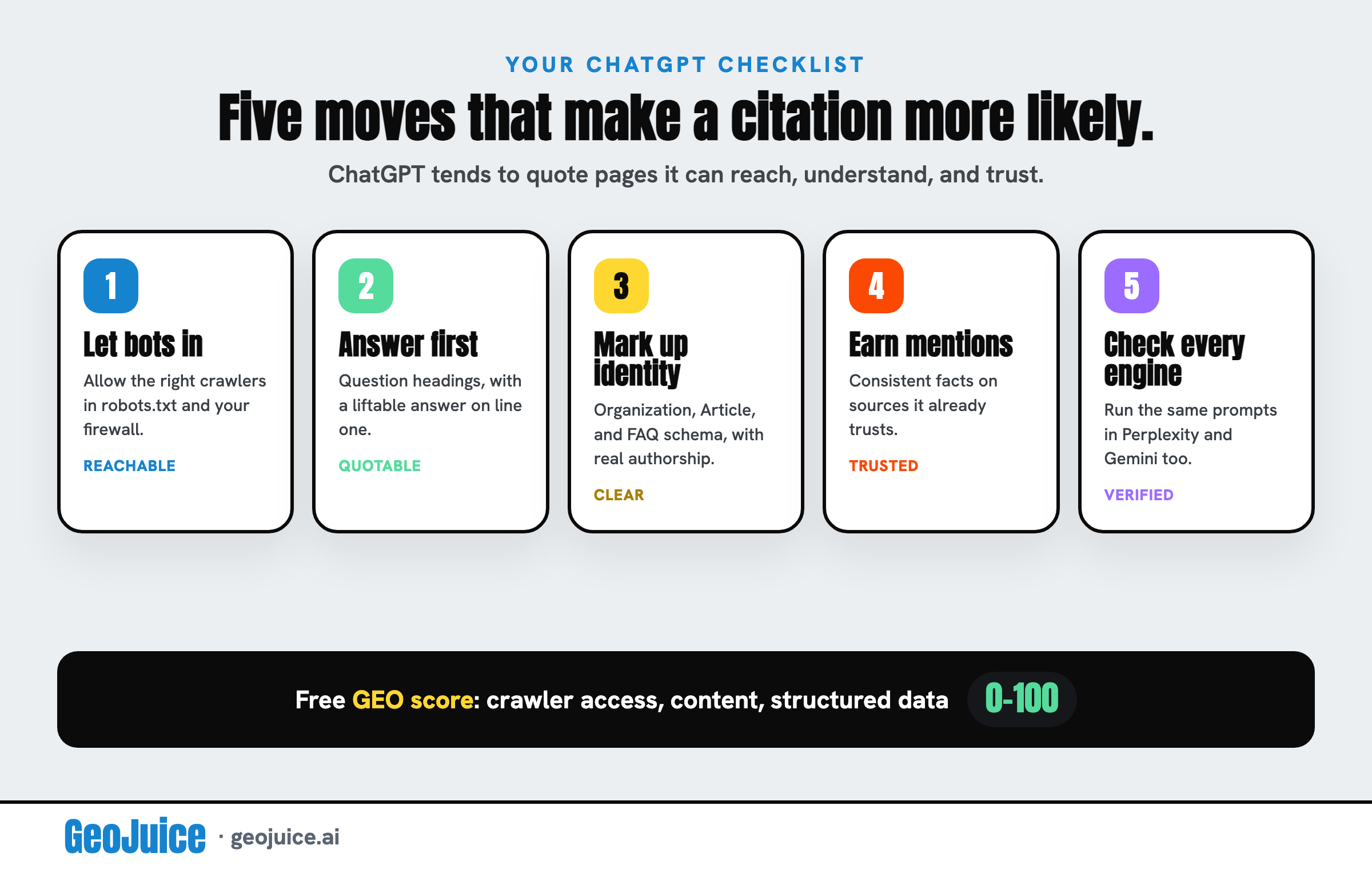
To get cited by ChatGPT, do five things: allow its search crawler in robots.txt (the file that tells bots what they may crawl) and your firewall, publish clear answer-first content, add structured data (code that labels who you are and what the page is), earn mentions on sources it already trusts, and re-check regularly. ChatGPT tends to cite pages it can reach, understand, and trust, so a miss on any one of them makes a citation much less likely.
How does ChatGPT decide what to cite?
When a question needs fresh or specific information, ChatGPT searches the web, gathers a set of candidate pages, and picks passages it can quote. OpenAI does not publish how ChatGPT picks sources, but cited pages tend to share three traits: they are reachable by its crawlers, they state things clearly enough to lift a sentence from, and they come from a source the model has reason to trust. Everything below serves one of those three.
First, test whether ChatGPT can reach you
Run your site through a free GeoJuice audit and you get a GEO (generative engine optimization) score, which measures how ready your site is to be cited by AI, on the 0 to 100 GEO Index. It includes whether AI crawlers such as GPTBot can reach your pages. The scan does not yet probe OAI-SearchBot, the crawler OpenAI uses to show sites in ChatGPT search results, so check that one with the request test in step 1. Crawler access is one of the three most heavily weighted signals, tied with structured data and on-page content, because a page no AI crawler can fetch has little chance of being quoted. The scan ranks the fixes so you know where to start.
1. Let OpenAI’s crawlers reach your site
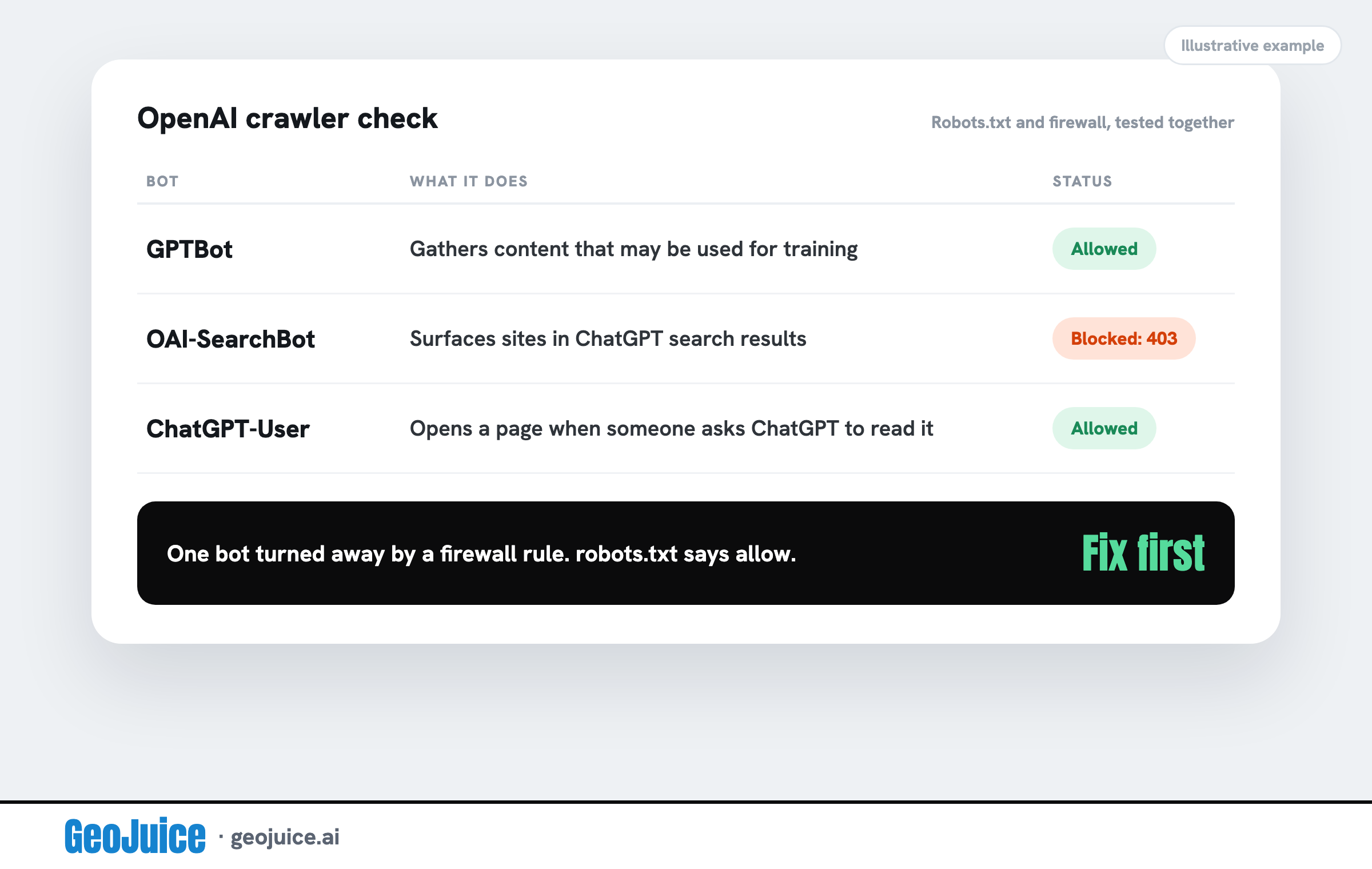
OpenAI uses three crawlers. GPTBot gathers content that may be used to train models. OAI-SearchBot is the crawler OpenAI uses to surface sites in ChatGPT search results. ChatGPT-User visits a page when someone asks ChatGPT to read it. Blocking OAI-SearchBot can keep you out of ChatGPT search results, while blocking GPTBot is a separate decision about training use, so choose each on purpose. OpenAI notes that robots.txt may not apply to ChatGPT-User, because a person starts those visits. Check OpenAI’s current bot documentation before you change a rule.
Then look past robots.txt. Many sites allow the bots on paper while a CDN, the network that serves your site, or a security plugin quietly returns a 403, an access-denied response, which is the same as being blocked. To test it, request one of your pages while identifying as the bot, which means setting its user agent, the name a crawler sends with each request. Check for a 200, the code for a page that loaded, rather than a 403, then repeat from a different network, because some firewalls treat bots differently by location. Some CDNs verify bots by IP address, so a spoofed test is a first check, not proof. Confirm in your CDN or firewall logs that requests from OAI-SearchBot are not blocked.
2. Write answer-first content
Phrase headings as the questions people actually ask, and make the first sentence underneath a clean answer that makes sense on its own. Models tend to quote short, direct statements, so a page that states its point in line one gives them something to lift, while one that buries it under backstory may be passed over. For example, open a product page with what the product does and who it is for, such as “GeoJuice scores how ready a website is to be cited by AI,” and save the company history for later.
3. Say who you are in structured data
Schema is the standard vocabulary for structured data. Article schema can state who wrote a page and when it last changed, and Organization schema states who the business is. OpenAI has not said how much ChatGPT relies on this markup, so treat schema as a label that helps machines read the page, not a vote of confidence.
4. Earn mentions on sites ChatGPT already trusts
Start with what you control. If your LinkedIn page says you serve dentists and your directory listing says clinics, a model has two stories to reconcile, so pick one description and use it word for word on every profile.
Then earn mentions on sites you do not control. A claim a model can confirm on a site you do not own is likely to carry more weight than one it can only read on yours, so reviews, directories, and press may do more for your odds than another page on your own domain. Search your brand name plus your category: if the only results are pages on your own domain, start with two or three listings or reviews you can earn this month.
5. Check Perplexity and Gemini, not just ChatGPT
ChatGPT, Perplexity, and Gemini do not agree on every answer. Perplexity and Gemini search the web separately from ChatGPT and often cite different pages for the same question, so a citation in ChatGPT tells you little about the other two. Do not chase each engine separately. Fix the basics once, then run the same set of buyer prompts in each and track the results monthly. The scan grades neither other engines nor outside mentions, so track both by hand.
Should I add an llms.txt file?
It is a small, low-cost signal, not a substitute for crawler access. llms.txt is a plain-text file that points AI tools to your best pages, and the scan grades it as the smallest of the six signals. The major engines have not confirmed that they rely on it, so treat it as an extra.
Can I guarantee ChatGPT will cite my site?
No. Nobody can promise a specific model will name you on a specific day, and anyone who does is guessing. What you can do is create the conditions that make a citation likely, then measure whether it is working.
How long until ChatGPT starts citing me?
Crawler and schema fixes can change what the model sees within days to a few weeks, once your pages are re-crawled. Building trust through consistent third-party mentions takes longer, and it depends on how quickly outside sources pick up your facts.
Do I need to publish a lot of new content?
Usually not. Most early wins come from fixing the pages you already have. Add content only where your buyers’ questions are not yet answered.
Can someone fix my ChatGPT visibility for me?
Yes. GeoJuice also offers done-for-you GEO, which carries out the fixes for you. Ask for a before-and-after GEO score on each fix, so you can see what moved.
Where should I start with GEO?
Get your free GEO score in about 30 seconds, with no email needed to see it, and fix the top-ranked issue first.
Steven Arevalo · Founder of GeoJuice
Steven is the founder of GeoJuice, the free GEO audit that shows how ready a website is to be cited by AI answer engines. An AI strategist at Lustra Labs, Steven previously consulted for Google Cloud, Waymo and Twitter, and founded Obituare.com, acquired in 2023.
Get new GEO guides by email.
One short email when a new guide is published. Unsubscribe any time.
Does your site have the juice?
Run a free audit and see your GEO Index in 30 seconds.
Get your GEO score