
Does schema markup help you get cited by AI?
By Steven Arevalo5 min read
Schema markup alone does not appear to make AI cite a page more. Ahrefs tracked 1,885 pages that added JSON-LD and found no clear citation gain in ChatGPT or Google's AI Mode, and a small drop in AI Overviews. Schema still helps machines tell who you are and what a page is. Put it after crawler access and visible text, keep it accurate, and test it on your own pages.
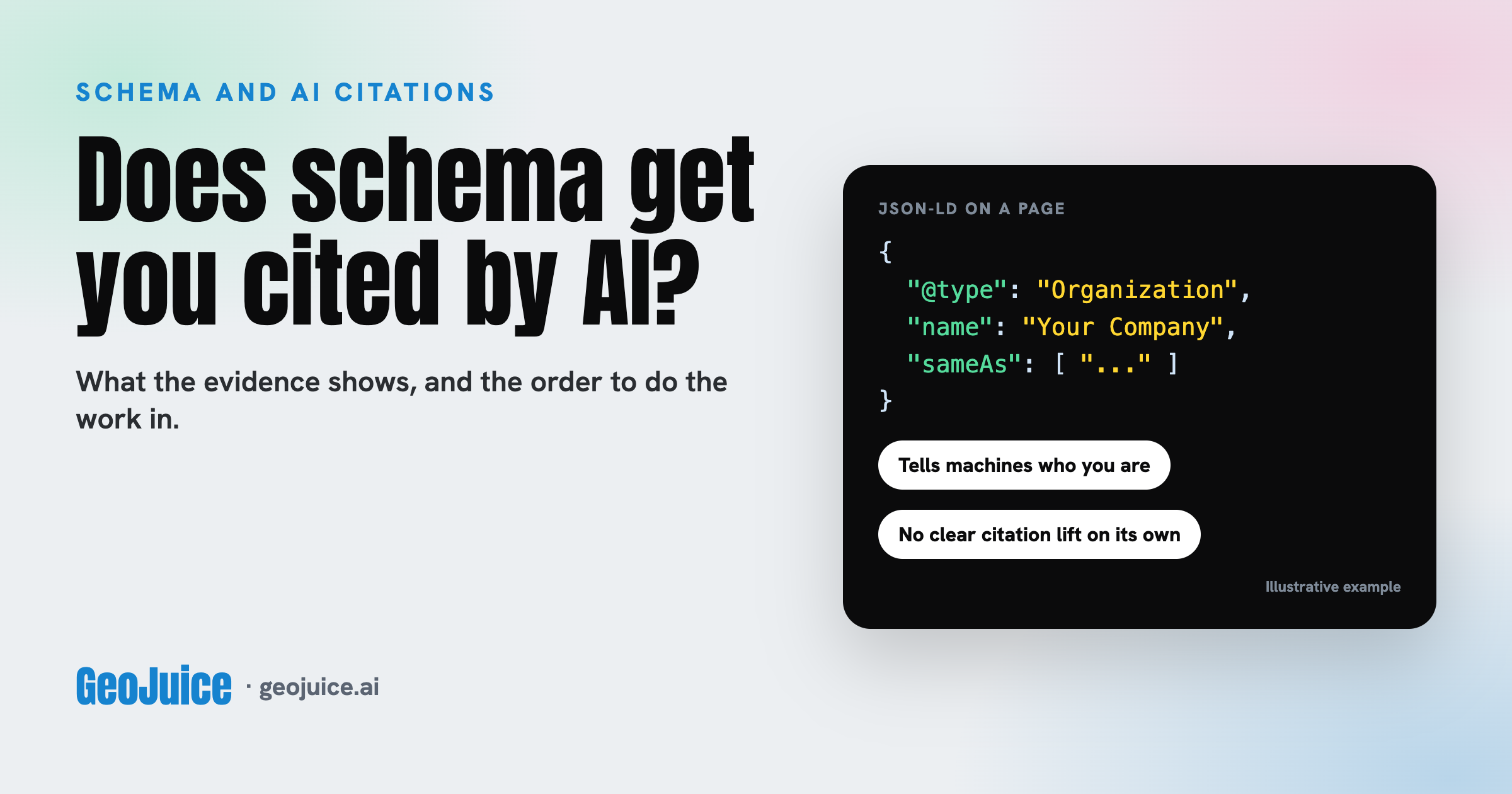
Does schema markup make AI cite your page more?
Schema markup is a block of code, usually JSON-LD, that labels what a page is: a company, an article, a product. Generative engine optimization (GEO) is the work of getting AI answer engines to name and cite your site, so it is fair to ask whether schema helps. So far the best evidence says it does not move citations by itself. Ahrefs found that pages AI cited were almost three times as likely to carry JSON-LD. It then tracked 1,885 pages that added JSON-LD and compared them with 4,000 similar pages that did not. It found no clear citation gain in ChatGPT or Google's AI Mode, and a small drop in AI Overviews.
The study had limits. Every page was already cited heavily, so it cannot say what schema does for a page that AI has never surfaced. The drop in AI Overviews is small, and Ahrefs could not explain it. Google's own documentation says no special schema.org markup is needed for its AI features. For the wider picture, read why your site is missing from AI answers.
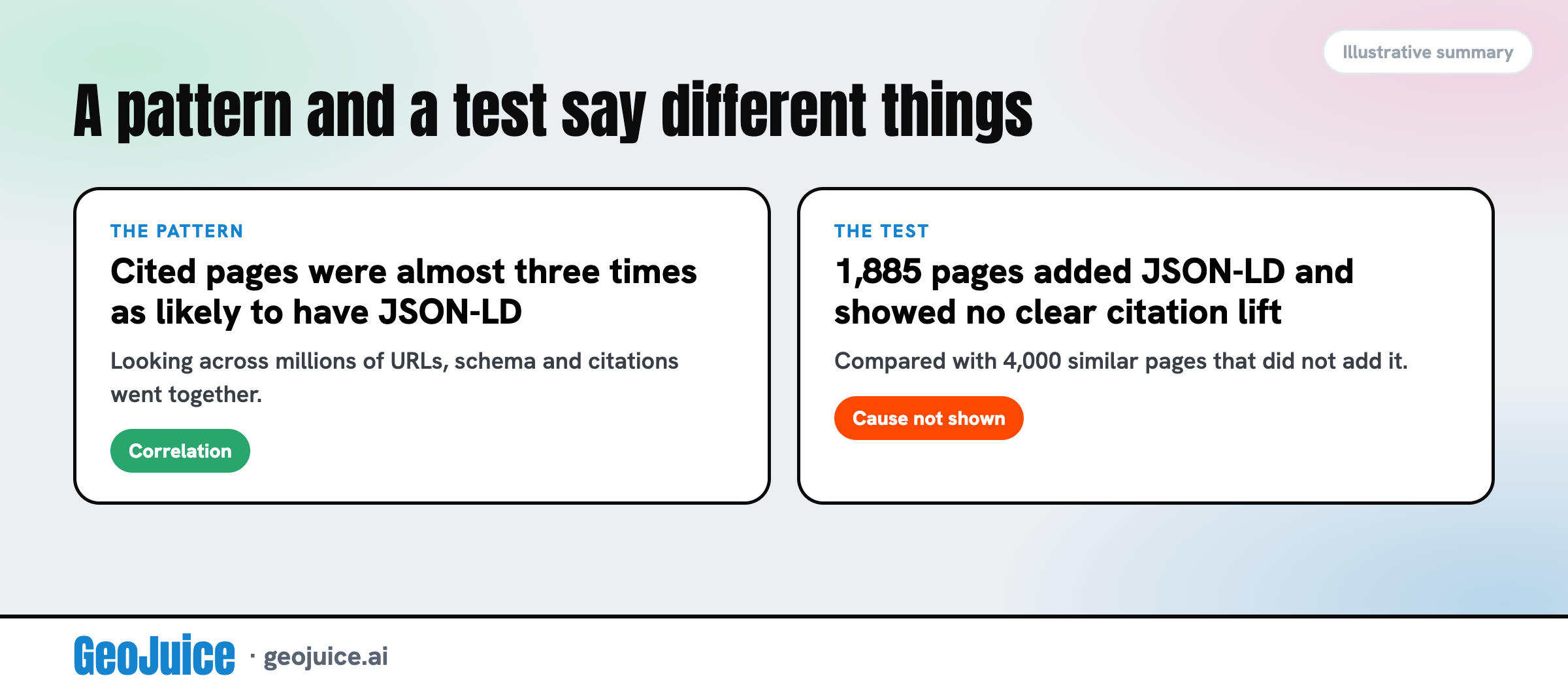
Why do cited pages have schema if it does not cause citations?
Ahrefs' explanation is that sites which add schema tend to look after everything else too: a clean technical setup, strong content, links, and regular updates. Those same traits get pages cited. For pages already being cited, schema looks like a sign of a well-kept site rather than the reason it is cited. Copying the markup without the rest of the work copies the sign and not the cause.
1. Check that AI crawlers can fetch your pages
Markup on a page that engines cannot fetch does nothing. Make sure search crawlers such as OAI-SearchBot and PerplexityBot are not turned away by robots.txt (the file that tells bots which pages they may crawl) or a firewall rule. Bot names change, so check each vendor's documentation. Your free GeoJuice scan gives you a GEO score on the 0 to 100 GEO Index, and crawler access is one of its six signals. No email is needed to see it. It requests your pages as GPTBot, ClaudeBot, PerplexityBot and Google-Extended, so check your OAI-SearchBot rule yourself. It measures readiness, not citations.
2. Put every important fact in visible text
In an experiment Ahrefs cites, five AI systems fetched a page live and none used facts that sat only in JSON-LD or hidden markup. They read the visible text. A price, a definition or a service area that appears only in markup may never reach an answer. Write it on the page first, in plain sentences under a clear heading.
3. Add schema that says who you are
Start with Organization schema: your name, your website address, your logo, and links to your other profiles in a property called sameAs. Add Article schema to posts, with the author and dates. This is the job markup is built for, telling machines which company and which page they are looking at. Clearer identity may help engines describe you correctly. Nobody has shown that it makes them cite you more.
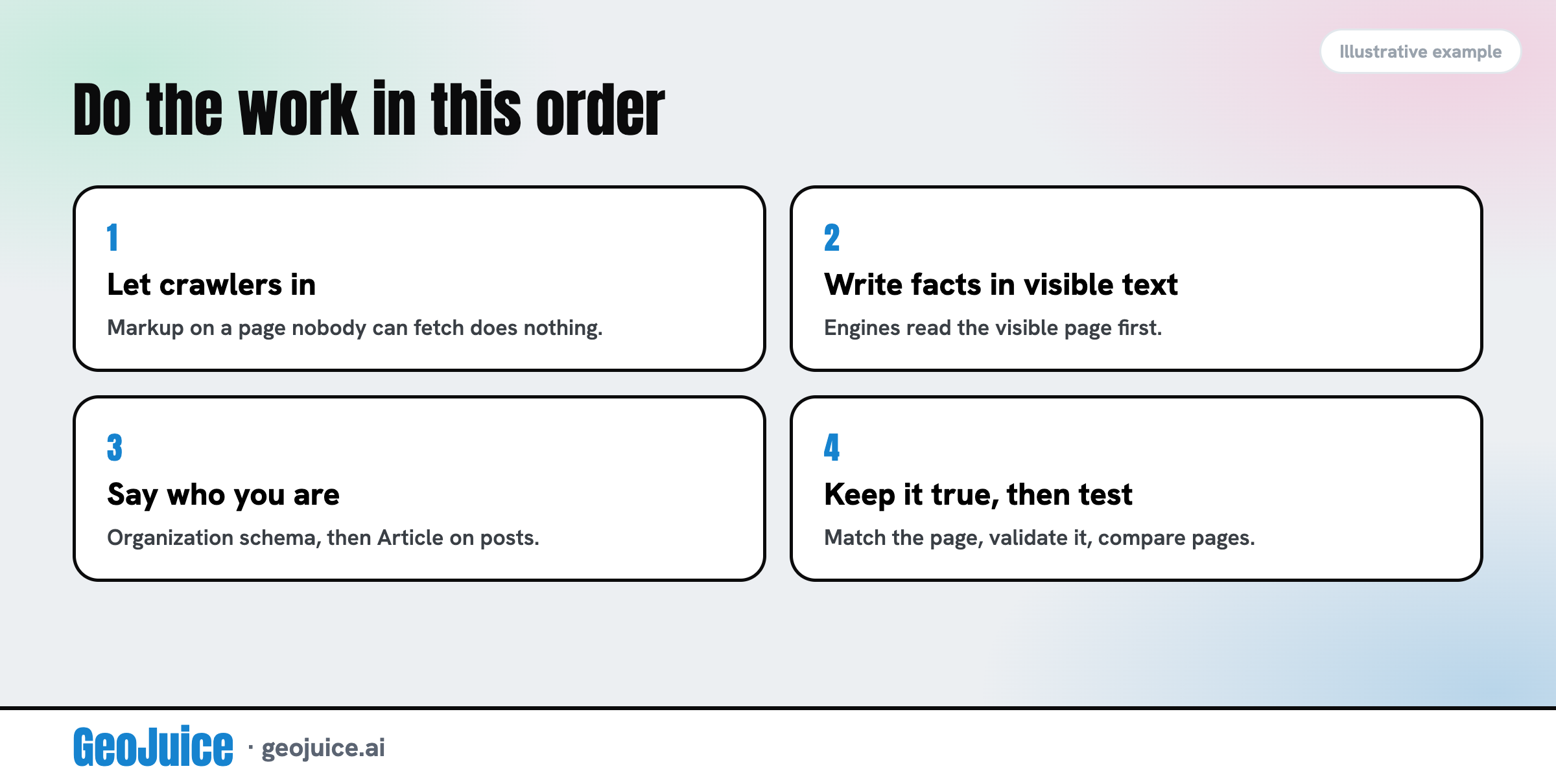
4. Keep the markup true, then validate it
Markup that disagrees with the visible page can be ignored by search engines and can cost you rich results, the enhanced search listings, such as review stars, that markup can enable. Update dates, prices and names whenever the page changes. Check the code with a free validator, such as Google's Rich Results Test or the Schema Markup Validator, before you publish.
5. Test the effect on your own pages
Ahrefs suggests running your own test, and the method is easy to copy. Say you run a plumbing company: add Organization schema to five service pages and leave five similar pages alone. Run the same ten buyer prompts for both groups before and after, using the method in how to benchmark whether AI names your brand. Wait about 30 days, the window the study used, then compare. If both groups moved together, the engines changed, not your markup.
After the schema: scan again and look at what is left
Re-scan with your free GeoJuice scan after you add markup. Its structured-data signal checks for JSON-LD and Organization schema, so it confirms the markup was detected. Then spend your next hour on the pages where AI still skips you. Nobody can promise that schema, or anything else, makes a specific engine name you on a specific day.
Should I add FAQ schema to every post?
No. Google's documentation says FAQ rich results are no longer shown in Search, so the markup no longer earns that display. Check its current documentation, since the types that earn rich results change. If you keep FAQ markup for other tools, the questions and answers must be visible on the page, word for word.
Is JSON-LD or Microdata better?
Use JSON-LD. Google recommends it in its structured data documentation. It sits in one script block, so you can add it without touching the page layout, whereas Microdata (markup written into the page's HTML tags) has to be woven through the page itself.
Can wrong schema hurt me?
It can. Google treats markup that misleads users as spam and can apply a manual action, which is a penalty a reviewer places on the site. Remove any markup you cannot keep current.
Does schema still matter for ordinary Google search?
Yes, for some things. It can make a page eligible for rich results such as event listings, where Google still offers them. That is a separate benefit from AI citations, and it is why many sites keep it.
Can someone add the schema for me?
Yes. GeoJuice also offers done-for-you GEO, which carries out the fixes the scan points to, such as adding Organization schema.
Steven Arevalo · Founder of GeoJuice
Steven is the founder of GeoJuice, the free GEO audit that shows how ready a website is to be cited by AI answer engines. An AI strategist at Lustra Labs, Steven previously consulted for Google Cloud, Waymo and Twitter, and founded Obituare.com, acquired in 2023.
Get new GEO guides by email.
One short email when a new guide is published. Unsubscribe any time.
Does your site have the juice?
Run a free audit and see your GEO Index in 30 seconds.
Get your GEO score