
Why do ChatGPT and Perplexity name different brands?
By Steven Arevalo5 min read
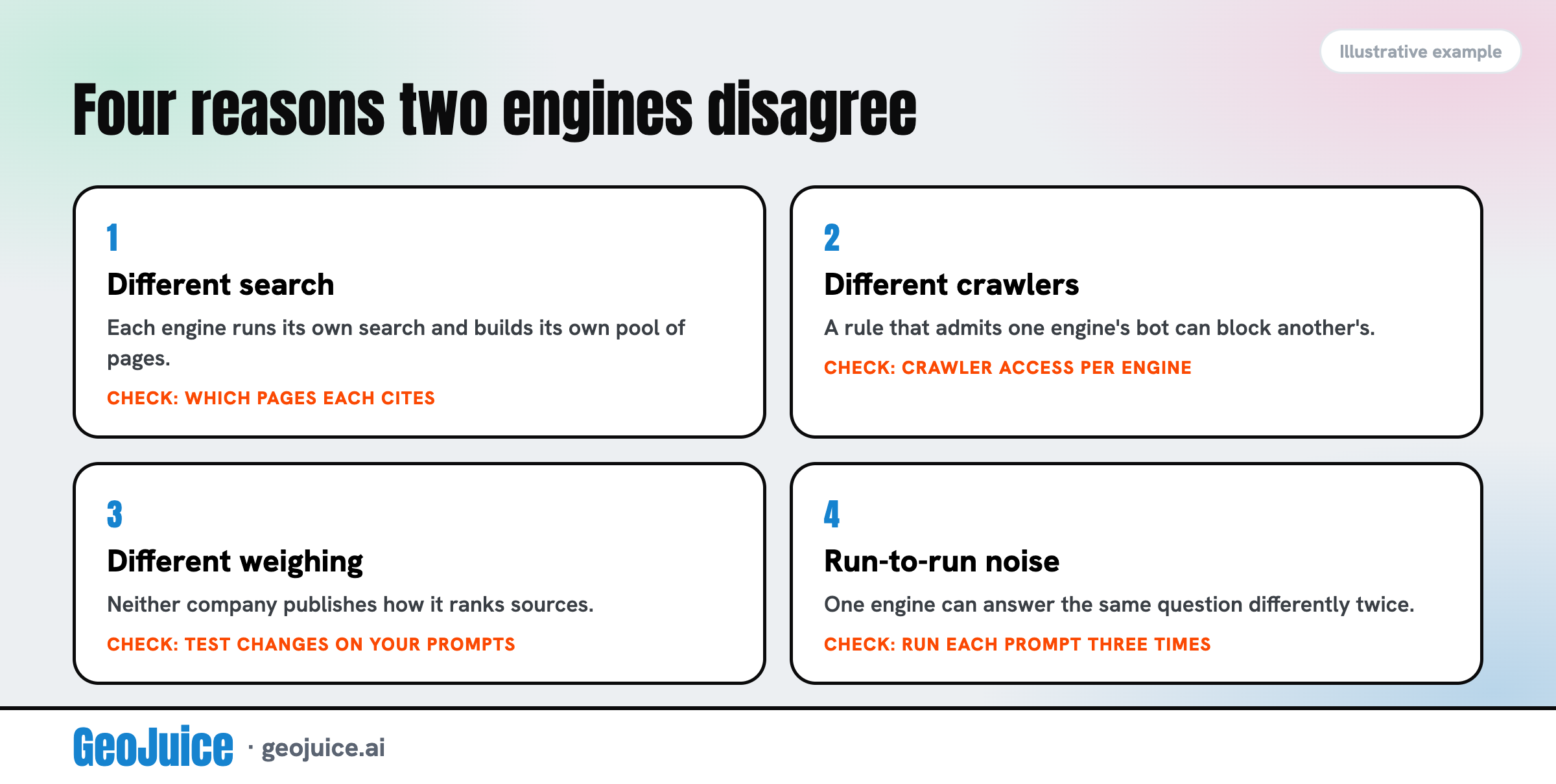
ChatGPT and Perplexity name different brands because each runs its own search, draws on different pages, and weighs sources in ways neither company publishes. Answers also change from run to run inside a single engine. To tell real disagreement from noise, run the same prompts three times in each engine, compare the pages each one cites, and check that each engine's crawler can reach your site.
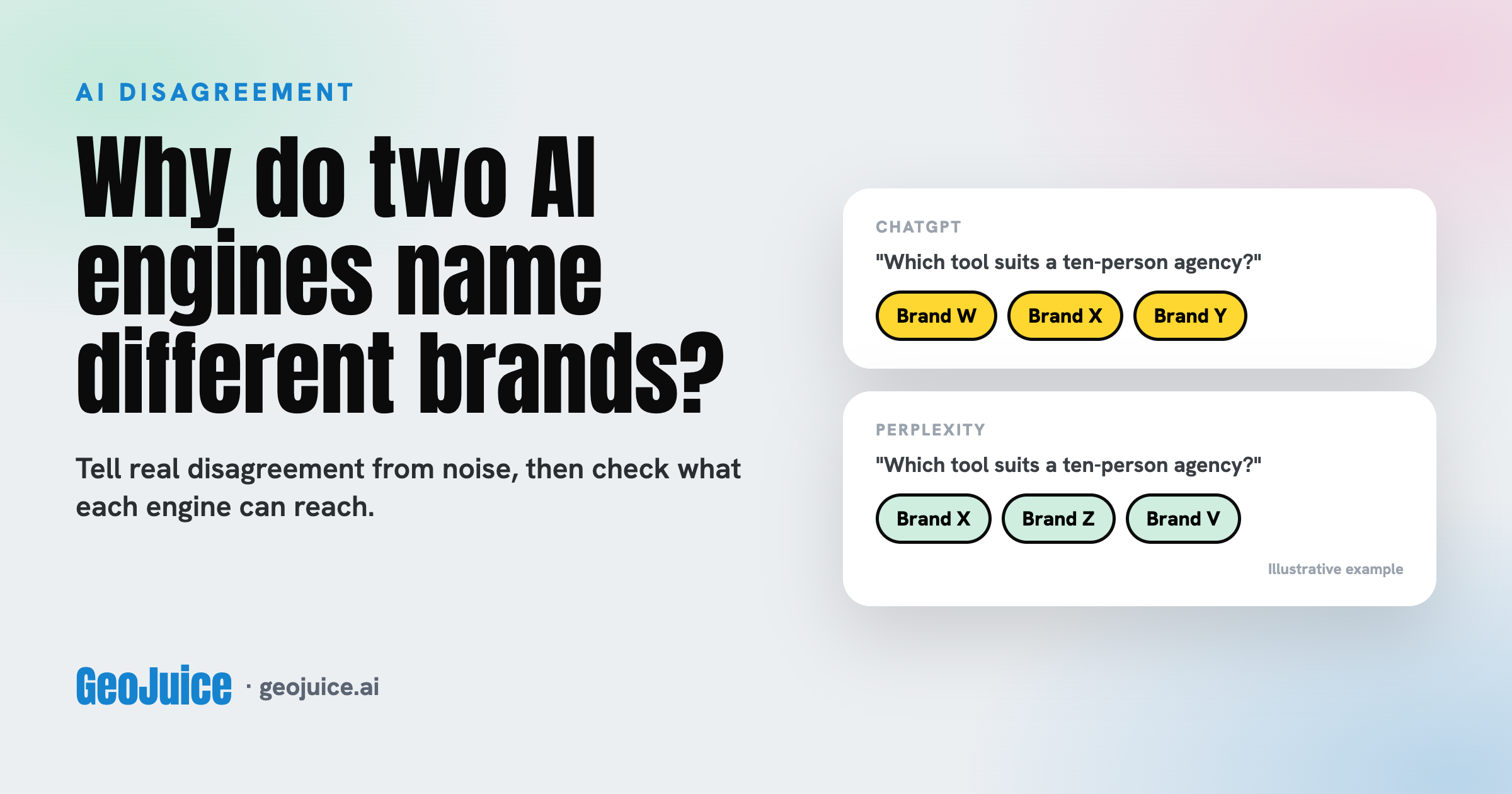
Why do two AI engines name different brands for the same question?
Generative engine optimization (GEO) is the work of getting AI answer engines to name and cite your site. Ask ChatGPT and Perplexity the same buyer question and you may get two different lists of brands. That is expected, not a sign that something broke. Each engine runs its own search and reads different pages. Part of any difference is plain noise. If you have not built a prompt set yet, start with how to benchmark whether AI names your brand. Step 4 uses your free GeoJuice scan.
1. Ask ChatGPT and Perplexity the same prompts under the same conditions
Write 10 to 20 buyer prompts that leave your own name out. Use identical wording in both engines, on the same day, with web search on where the app offers it. Save every full answer and any sources shown. When an answer shows no sources, write “sources not shown” instead of guessing where it came from.
2. Run each prompt three times to separate noise from real disagreement
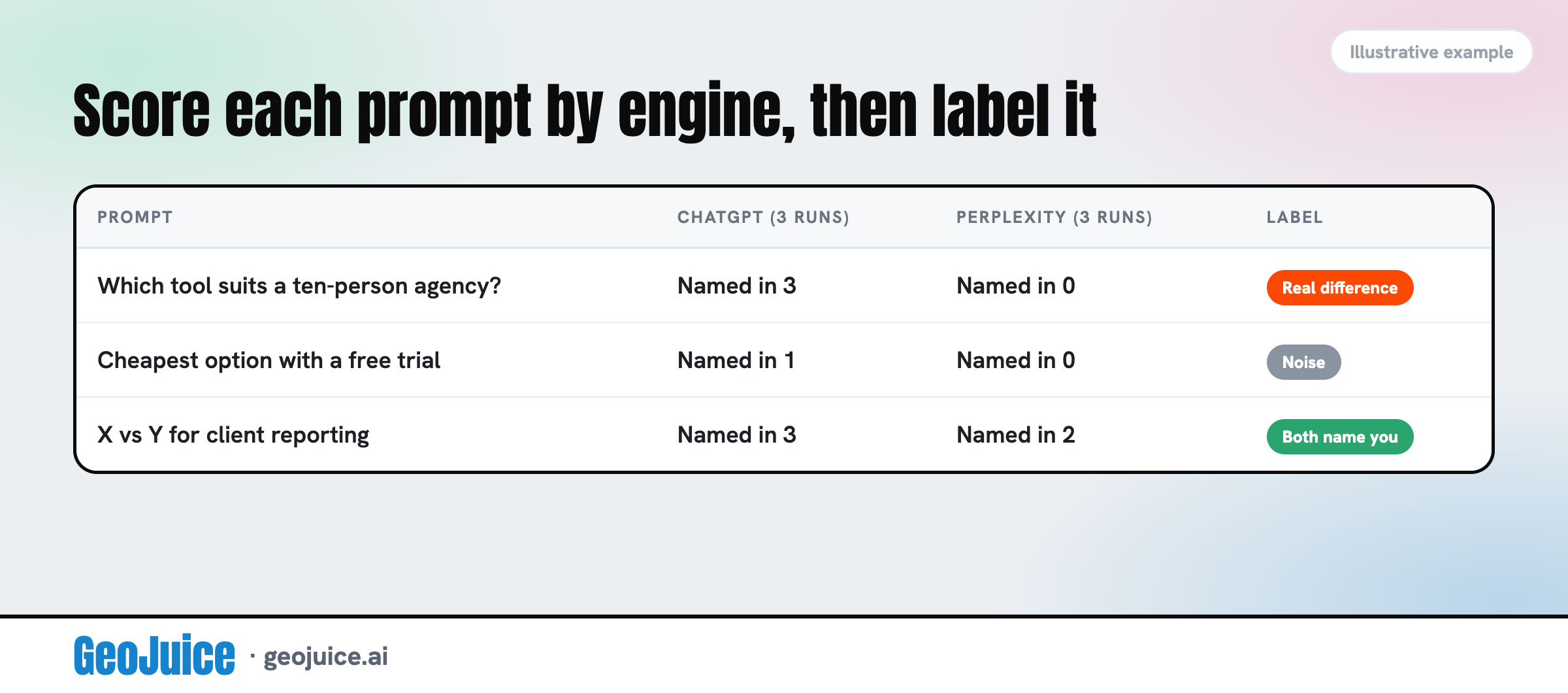
A single answer proves little, because an engine can name different brands each time you ask. As a rule of thumb, count a brand as named only when it appears in at least two of three runs. If one engine names you in two or three runs and the other never does, that is a real difference. If you appear once in three runs on either engine, treat it as noise and move on.
3. Compare the pages each engine cites for the brands it names
For each real difference, open the pages cited beside the brands each engine named. Do both engines lean on the same sites, or on different ones? One may cite a review roundup that mentions a rival while the other cites the rival's own page. Differences in cited sources often explain the split, though engines do not show them in every answer. Treat every pattern you find as a lead to test, not a rule.
4. Check that each engine's crawler can reach your site
Each engine sends its own crawler to fetch pages, such as OpenAI's OAI-SearchBot and Perplexity's PerplexityBot, though some also draw on outside search results. A firewall or bot rule can admit one and turn away the other. Bot names change, so check each vendor's documentation. If one engine never names you, start with the server logs for that engine's bot.
Your free GeoJuice scan gives you a GEO score on the 0 to 100 GEO Index, and crawler access is one of its six signals. It takes about 30 seconds, with no email needed to see it. It measures readiness, not citations. It requests your page as GPTBot, ClaudeBot, and PerplexityBot, so it can catch a firewall rule that turns one of them away, but it does not test OAI-SearchBot, so check your logs for that one.
5. Fix what helps every engine read and quote your site, then re-run the same prompts
Avoid tricks aimed at one engine; ranking rules are not public. Fix crawler access first. An engine whose bot is turned away cannot read your newest pages, so it has to lean on older data or on what other sites say about you. Re-scan after the fix to confirm each bot now gets through before you re-run your prompts. Next add a direct answer under each question on your key pages. A matching name and description across your listings is slower work and can follow. Re-run the same prompts after engines have had time to re-crawl, which can take weeks, and neither company publishes a schedule. Nobody can promise that a specific engine will name you on a specific day.
Keep one log that scores every prompt on ChatGPT and Perplexity side by side
Add an agreement label to every prompt: both engines name you, one names you, or neither does. The rows where only one engine names you are the most useful.
Does turning web search off change which brands are named?
It can. Without web search an engine leans on what it learned in training, and may name different brands than it does with search on. Answers from a no-search mode tend to reflect older training data, so do not use them to judge recent site changes.
How many prompts must show one engine naming you and the other not before you act?
Look for the same engine-only pattern across several prompts in one buyer intent, not a single row. As a rule of thumb, three or more rows with the same label is a sensible bar for acting.
Which AI engine should you test first?
The one your buyers use. Ask new customers which assistant they tried first, and weight your prompts toward it. Your own preference tells you little about where your buyers look.
Can someone fix the site issues the GeoJuice scan points to?
Yes. GeoJuice also offers done-for-you GEO, which carries out the fixes the scan points to, such as crawler access and on-page answers.
Do Gemini and Claude also name different brands from ChatGPT and Perplexity?
They can. Gemini can draw on Google Search results for some answers, so its picks may track Google more closely. Add Gemini and Claude to the log one engine at a time, so a change in your totals has one cause.
Steven Arevalo · Founder of GeoJuice
Steven is the founder of GeoJuice, the free GEO audit that shows how ready a website is to be cited by AI answer engines. An AI strategist at Lustra Labs, Steven previously consulted for Google Cloud, Waymo and Twitter, and founded Obituare.com, acquired in 2023.
Get new GEO guides by email.
One short email when a new guide is published. Unsubscribe any time.
Does your site have the juice?
Run a free audit and see your GEO Index in 30 seconds.
Get your GEO score