
Can ambiguity keep AI from recommending you?
By Steven Arevalo5 min read
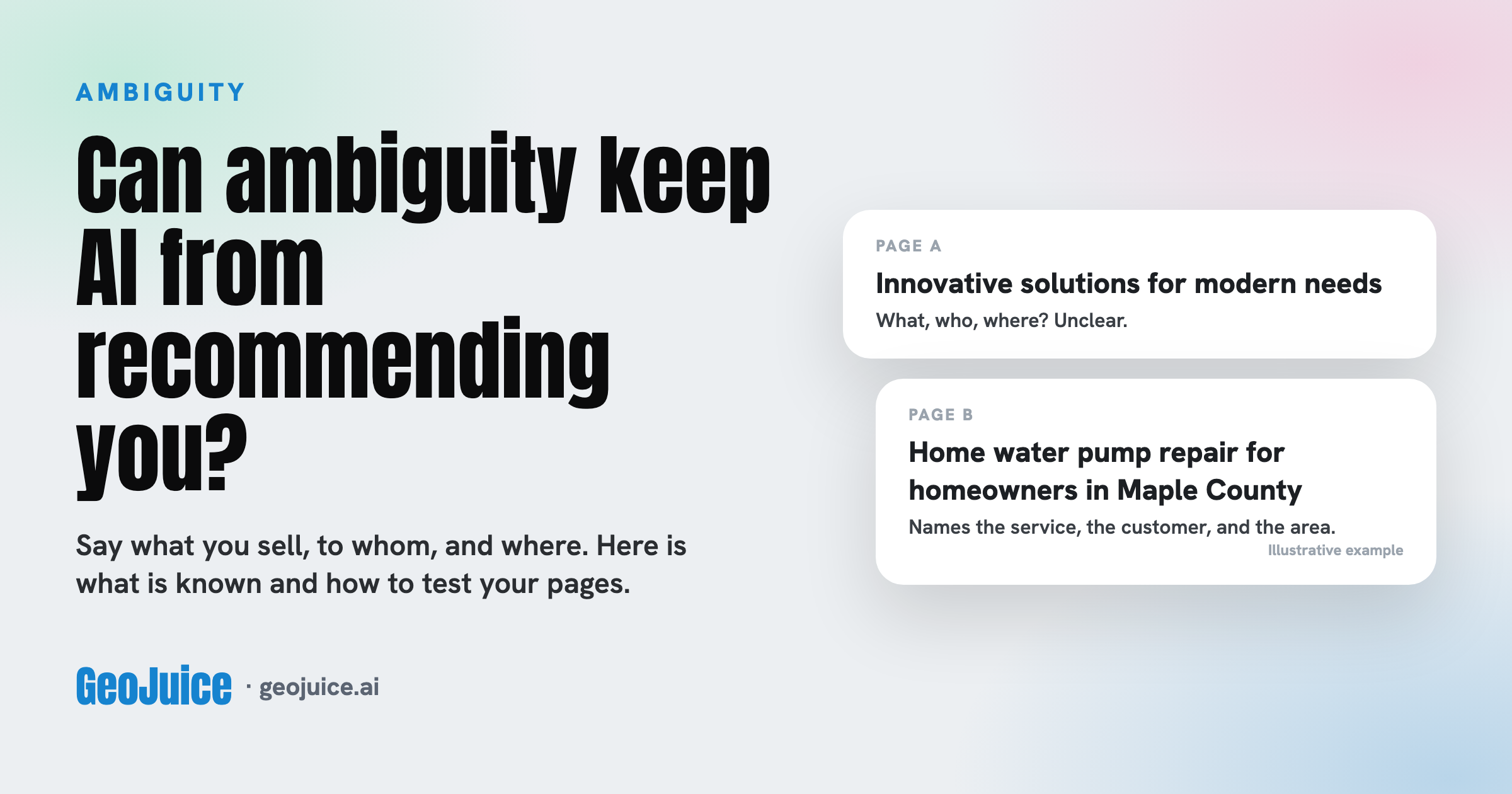
Ambiguity means your pages leave it unclear what you sell, to whom, and where. No AI company publishes how its engine treats vague pages, so a link to fewer recommendations is a plausible idea, not a shown fact. What you can do is state those three things in plain words on every key page and make sure crawlers can read the text.
Can ambiguity keep AI from recommending you?
Generative engine optimization (GEO) is the work of getting AI answer engines to name and cite your site. In this post, ambiguity means pages that leave a reader unsure what you sell, who it is for, or where you work. A person can skim past that. An engine that builds an answer from your text has less to quote.
Before you rewrite anything, start with the free GeoJuice scan to see whether engines can read your pages.
1. What is documented about vague pages?
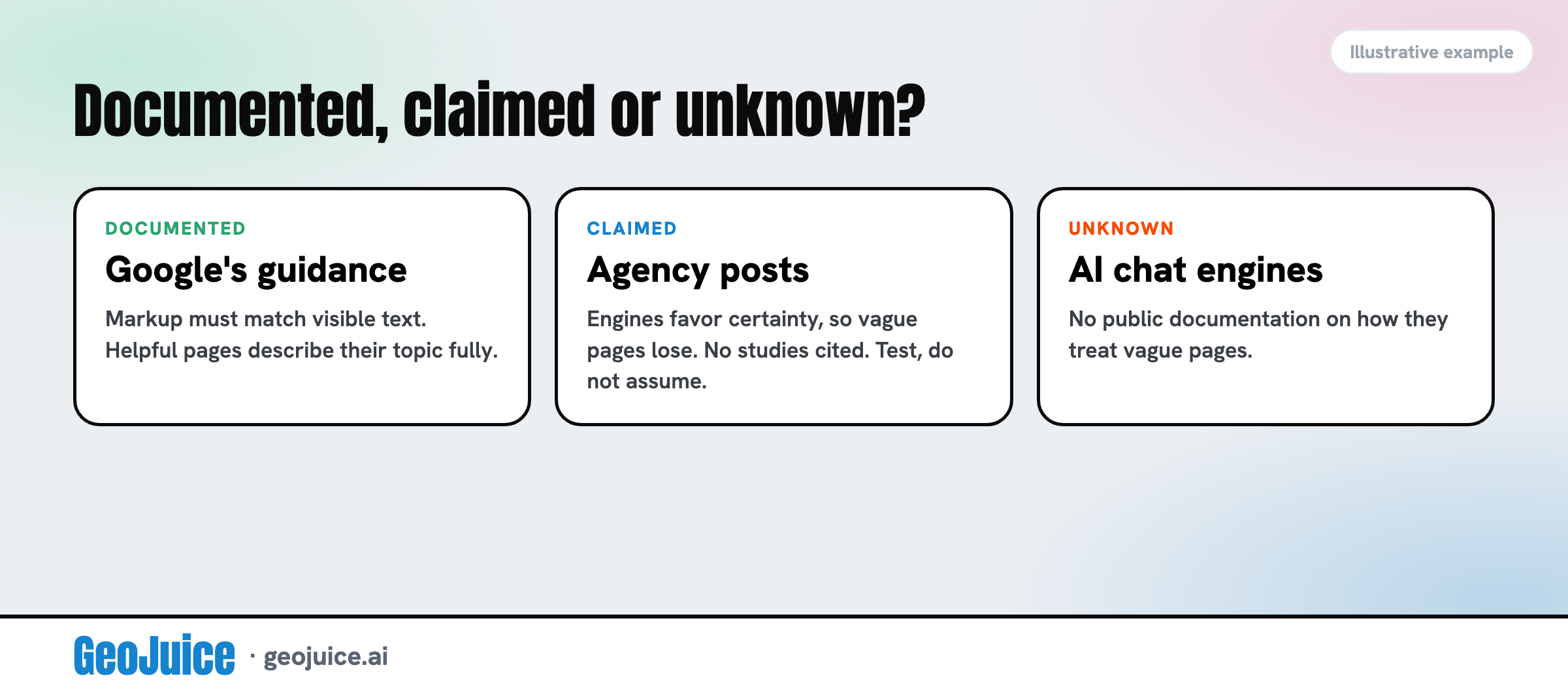
Two Google Search Central texts touch the topic, and both are about Google Search, not AI chat engines. Its people-first content guidance asks, among other questions, whether a page gives a substantial, complete description of its topic. Its guidelines for structured data, which is code that labels facts such as your services and address for machines, say that markup must describe content visitors can see on the page.
The second point matters here. Markup cannot rescue a vague page, because it has to match the words already on it. We could not find public documentation from the AI chat companies on how they treat vague pages.
2. What is only claimed about ambiguity?
At least one agency that sells GEO services calls ambiguity the top risk. Its argument is that engines favor certainty, that vague information lowers an engine's confidence, and that it then names a clearer competitor. The post we read cites no studies for this.
The idea is plausible, because an answer needs a plain statement to quote. Plausible is not the same as shown. Treat it as a hypothesis to test on your own pages.
3. What does an ambiguous page look like?
The patterns are easy to spot once you look. An opening line describes a feeling, such as “We help businesses grow,” instead of an offer. Jargon appears that your customers never use. One page covers several services with no clear headings. Basic facts such as the area you serve or who the service is for are missing.
This differs from entity dilution, where facts conflict across several sites. Ambiguity lives in your own wording. See what entity dilution is for that problem.
4. How do you test your own pages?
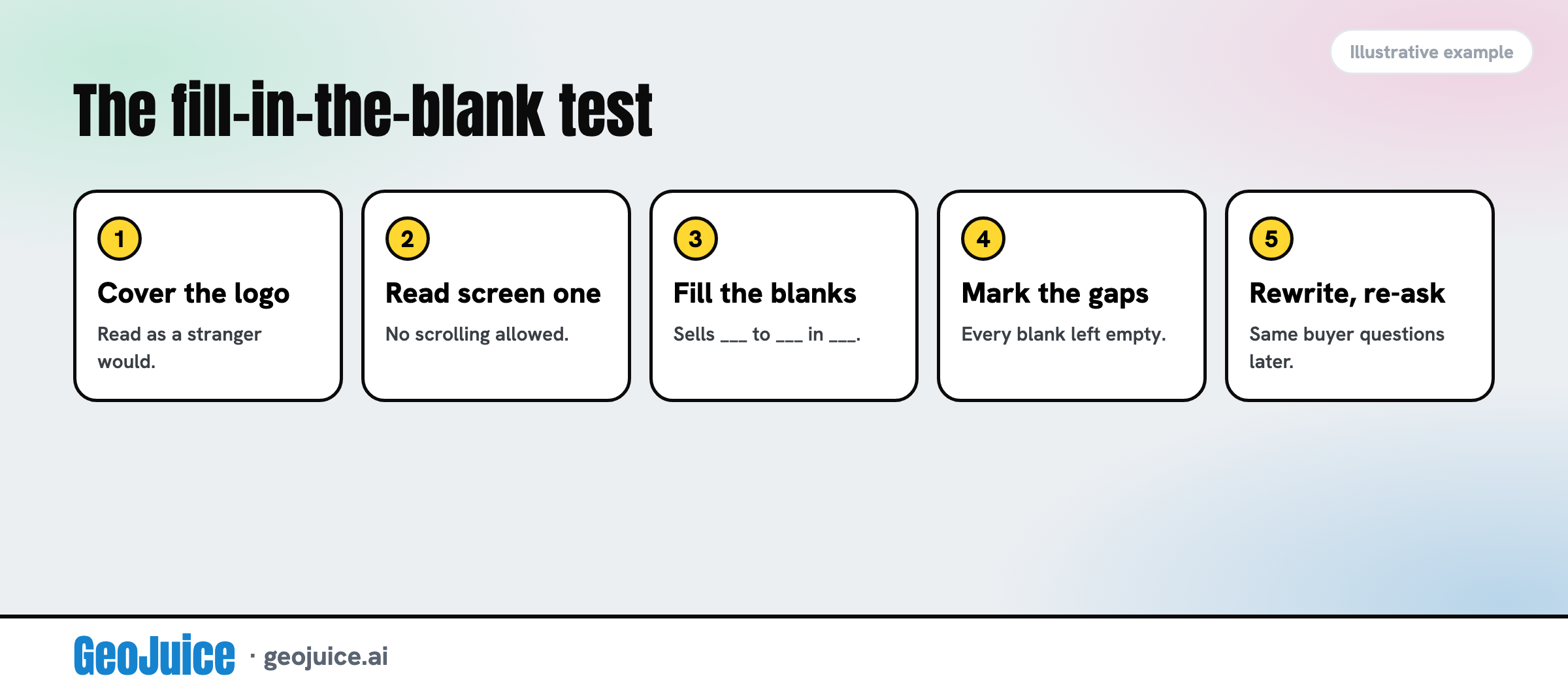
Use a fill-in-the-blank test. Cover your logo, read only the first screen of your home page or a service page, and try to finish this sentence: “This business sells ___ to ___ in ___.” Ask someone who does not know your business to do it without scrolling. Mark every blank they cannot fill.
Then ask an AI engine a buyer question you want to win, such as “Who offers [your service] in [your city]?” Note whether any of your wording appears, and keep the answers in a sheet to compare later.
5. How do you remove the ambiguity?
Rewrite the first sentence of each key page so it names what you sell, to whom, and where. Use the words customers use. Give each service its own page and heading, and state facts such as area served and what is included in plain text, not only in images.
Do this before you add any markup.
6. Can engines read your clearer wording?
Clear text helps only if crawlers can reach it. Your free GeoJuice scan gives you a GEO score on the 0 to 100 GEO Index across six signals, in about 30 seconds, with no email needed. It measures readiness, not citations, and cannot judge whether your wording is clear. It can show whether AI crawlers get through and whether your text sits in the page, not in an image or script. Bot names change, so check each vendor's documentation.
After the rewrite, how do you check whether it helped?
Wait until engines have had time to re-read the pages, which can take weeks. Then ask the same buyer questions with the same setup and compare the answers. Nobody can promise that an engine will name you on a given day, so judge the change across the whole set. Next step: run the free GeoJuice scan on the first page you rewrite.
Does a longer page remove ambiguity?
No. Length adds no clarity, and a long page can still never say who it is for. Add the missing facts and cut the filler.
Should I write for AI or for people?
Write for people first. Wording that a customer understands at a glance is also easy for a machine to quote, and nothing here requires text that reads oddly to a human.
Can I keep technical terms on my pages?
Yes, if your buyers use them. Pair each term with a plain version the first time it appears, and say what it means for the reader.
Can someone rewrite my pages for me?
Yes. GeoJuice also offers done-for-you GEO, which carries out the fixes the scan points to. Re-scan afterward to see how your GEO score changes.
Steven Arevalo · Founder of GeoJuice
Steven is the founder of GeoJuice, the free GEO audit that shows how ready a website is to be cited by AI answer engines. An AI strategist at Lustra Labs, Steven previously consulted for Google Cloud, Waymo and Twitter, and founded Obituare.com, acquired in 2023.
Get new GEO guides by email.
One short email when a new guide is published. Unsubscribe any time.
Does your site have the juice?
Run a free audit and see your GEO Index in 30 seconds.
Get your GEO score