
How should a B2B SaaS company approach GEO?
By Steven Arevalo5 min read
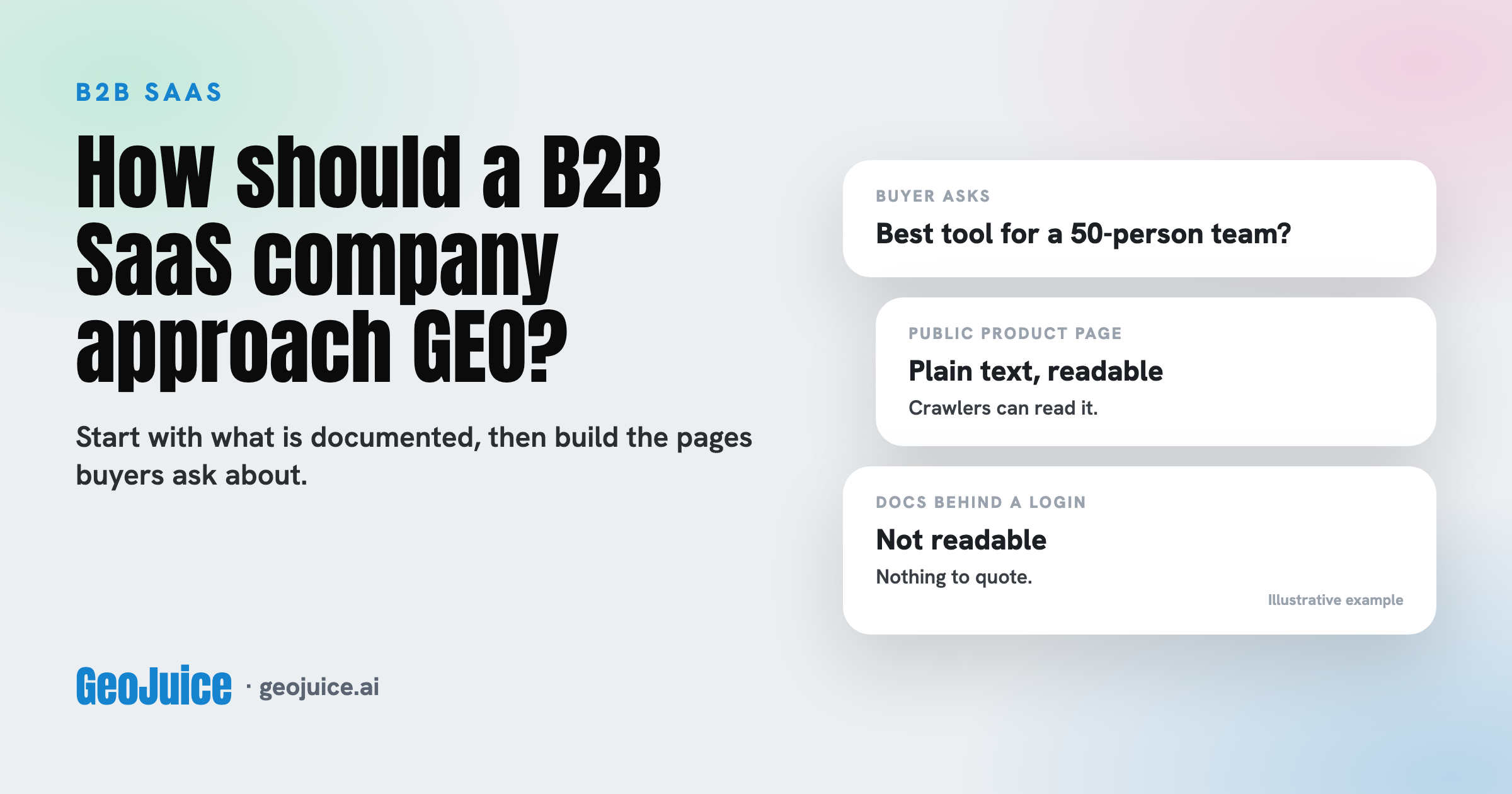
Start with what you can verify. Let the crawlers behind AI search read your public pages, say in plain words what your product does and for whom, and publish pages for the questions buyers ask before a demo. How engines build vendor shortlists is not documented, so treat claims about review sites and rankings as hypotheses and measure your own results.
How should a B2B SaaS company approach GEO?
Generative engine optimization (GEO) is the work of getting AI answer engines to name and cite your site. Software buyers may ask an AI tool for “the best tool for X” or “X versus Y” before they ever visit a vendor. Vendor surveys put numbers on how many buyers do this, but we could not verify them, so this post does not rely on them.
Before you change anything, start with the free GeoJuice scan to see whether engines can read your public pages.
1. What is documented about AI crawlers?
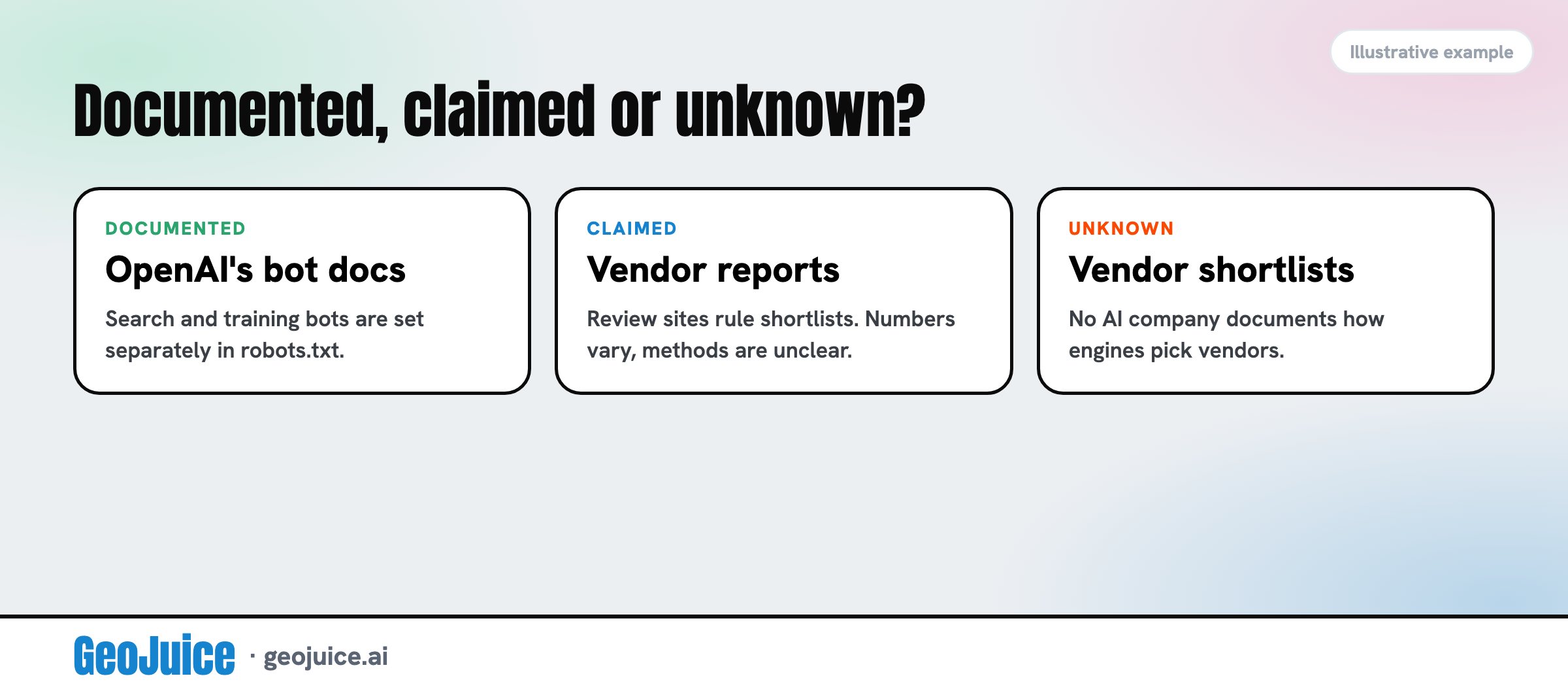
OpenAI's crawler documentation lists separate bots. OAI-SearchBot surfaces sites in ChatGPT search, and GPTBot relates to model training. Each is controlled in robots.txt, the file that tells crawlers which pages they may read. The documentation says a site that blocks OAI-SearchBot will not be shown in ChatGPT search answers.
For a software company this has a practical edge. A team that blocks every AI bot over training concerns also blocks the search bot, and a firewall or bot-protection service can block crawlers even when robots.txt allows them.
2. What is only claimed about B2B software and AI?
Agencies and tool vendors claim that review sites such as G2 and Capterra dominate shortlists, that engines favor technical documentation, and that a set number of buyers start in a chatbot. Their sources disagree, their methods are often only partly documented, and we could not find documentation from any AI company on how engines build vendor shortlists.
Treat those claims as hints. Several are plausible, because outside reviews and clear documentation are easy to quote. Plausible is not the same as shown, so test each one on your own market.
3. Which pages answer the questions buyers ask?
Start from what a buyer asks before a demo. What does it do? Who is it for? How does it compare with the alternatives? Which tools does it connect to? Is it secure? How does pricing work?
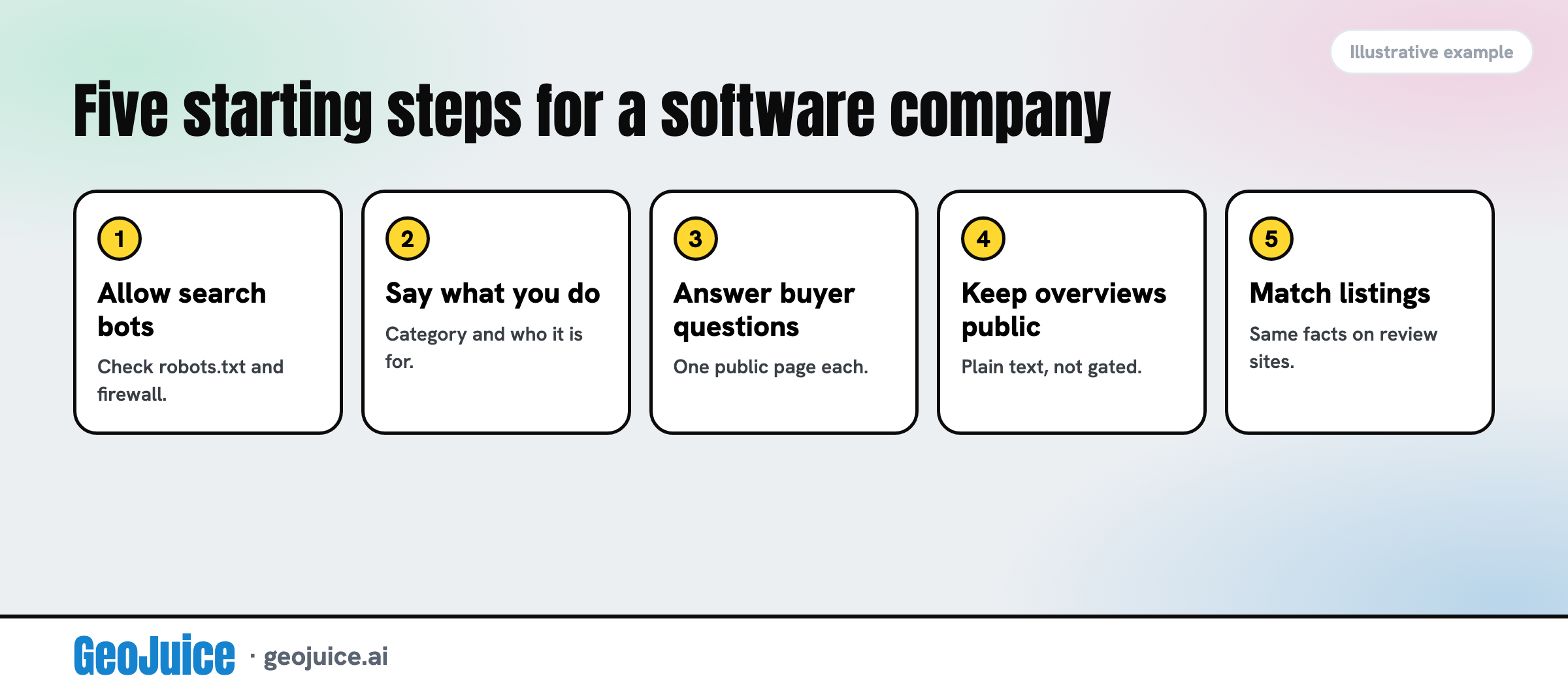
Give each question a public page with a plain heading and a direct first sentence.
4. How do you say what your product does?
Name your category in the words buyers use, then say who the product is for. The fill-in-the-blank test in can ambiguity keep AI from recommending you works well on a product home page. Software companies often lead with a slogan, so the test usually finds a blank.
Then keep the description identical on your site, your review listings, and your directory profiles. What entity dilution is covers how mismatched facts build up.
5. What should stay public, and what can stay gated?
A crawler can only read what a public address serves. Product overviews, integration lists, and a security page behind a login are out of reach, and pages that load only through scripts may be missed by crawlers that do not run scripts. Publish those overviews as plain page text and gate only what must be private. Whether engines use documentation to pick vendors is unproven, but a missing page can never be cited.
6. Can engines read your public pages today?
Do this first: crawler access and public pages come before review listings and comparison pages, which can wait. Your free GeoJuice scan gives you a GEO score on the 0 to 100 GEO Index across six signals, with no email needed. It measures readiness, not citations. It requests your page as GPTBot, ClaudeBot, and PerplexityBot, so it can catch a firewall rule that turns one away. It does not test OAI-SearchBot, so check your logs for that one.
After the changes, how do you measure the result?
Write five shortlist questions your buyers ask, such as “best [category] for [team type].” Ask an AI engine each one with the same setup, and record whether you appear and who does. Repeat after engines have had weeks to re-read your pages. Nobody can promise a place on a shortlist, so judge the change across the whole set. Next step: run the free GeoJuice scan on your product overview page.
Should AI crawlers read my docs and changelog pages?
Allow them if the pages are public and accurate. Old pages for retired features may confuse a reader or an engine, so mark outdated pages clearly or redirect them to the current version.
Is it safe to publish a competitor comparison page?
Yes, if every claim is accurate and checkable. Describe your own product in detail, state only what you can verify about the other vendor, and date the page so readers know when you last checked it.
Does GEO replace search engine optimization (SEO) for a software company?
Nothing we found says so. Pages that search engines can read are also what AI crawlers read, so the groundwork overlaps. Treat GEO as extra checks on top of your search work.
Can someone set this up for my team?
Yes. GeoJuice also offers done-for-you GEO, which carries out the fixes the scan points to. Re-scan afterward to see how your GEO score changes.
Steven Arevalo · Founder of GeoJuice
Steven is the founder of GeoJuice, the free GEO audit that shows how ready a website is to be cited by AI answer engines. An AI strategist at Lustra Labs, Steven previously consulted for Google Cloud, Waymo and Twitter, and founded Obituare.com, acquired in 2023.
Get new GEO guides by email.
One short email when a new guide is published. Unsubscribe any time.
Does your site have the juice?
Run a free audit and see your GEO Index in 30 seconds.
Get your GEO score