
What is entity dilution, and can it hide you from AI?
By Steven Arevalo5 min read
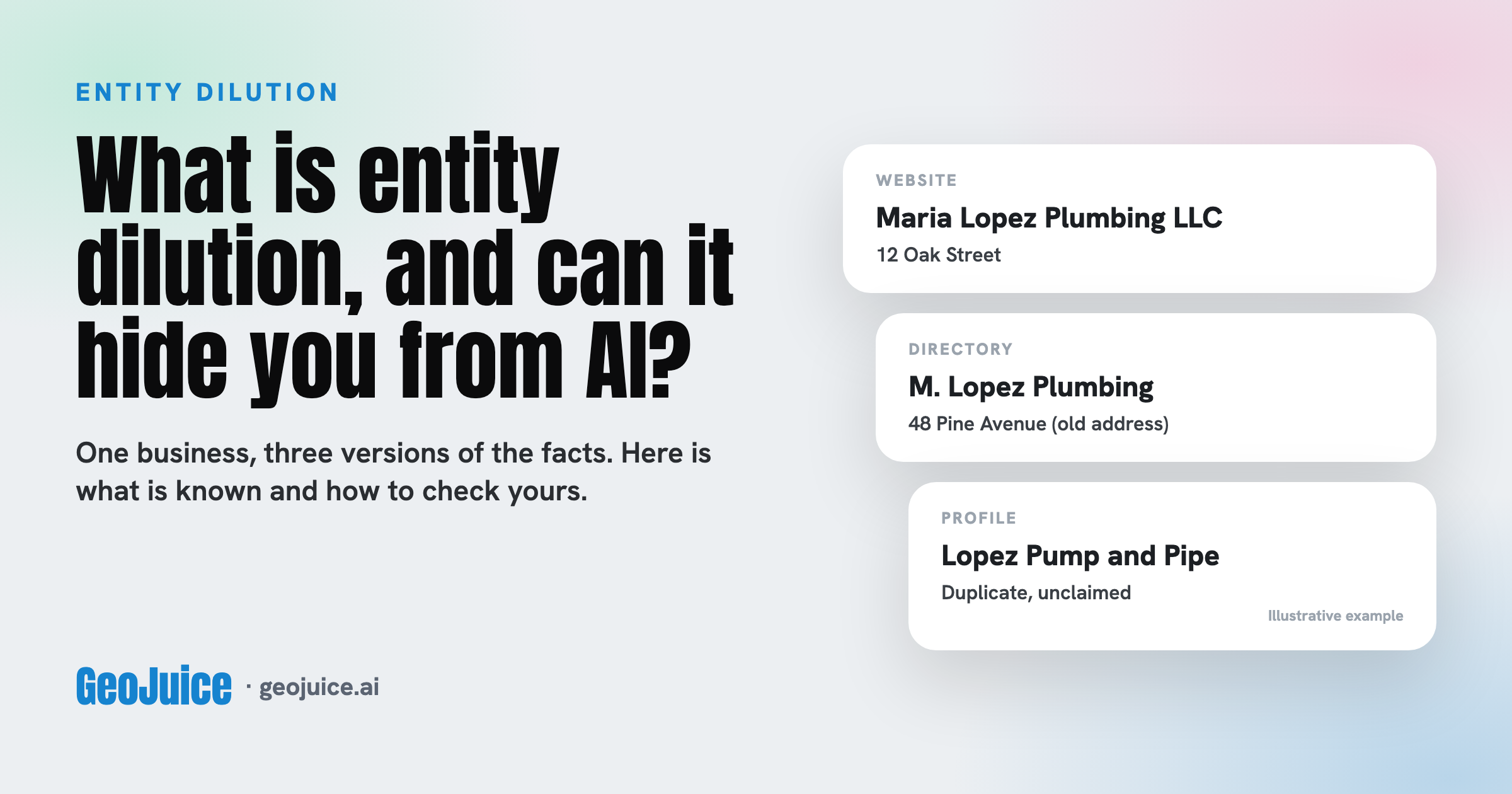
Entity dilution is an industry term, not a formal standard, for a business that the web describes in conflicting ways: different names, old addresses, duplicate profiles. When facts disagree, an engine may have to guess whether they describe one business or several, so it may mix your details with another business or leave you out. No AI company publishes how it resolves this, so check your own facts, make them match, and treat bigger claims as untested.
What is entity dilution?
Generative engine optimization (GEO) is the work of getting AI answer engines to name and cite your site. Entity dilution is an industry term, not a formal standard, for a business that the web describes in conflicting ways.
An entity here means one identifiable business or person that a machine can recognize. When the facts disagree, an engine may have to guess whether they describe one business or several.
Before you change anything, start with the free GeoJuice scan to see whether engines can read your own site.
1. What is documented about telling businesses apart?
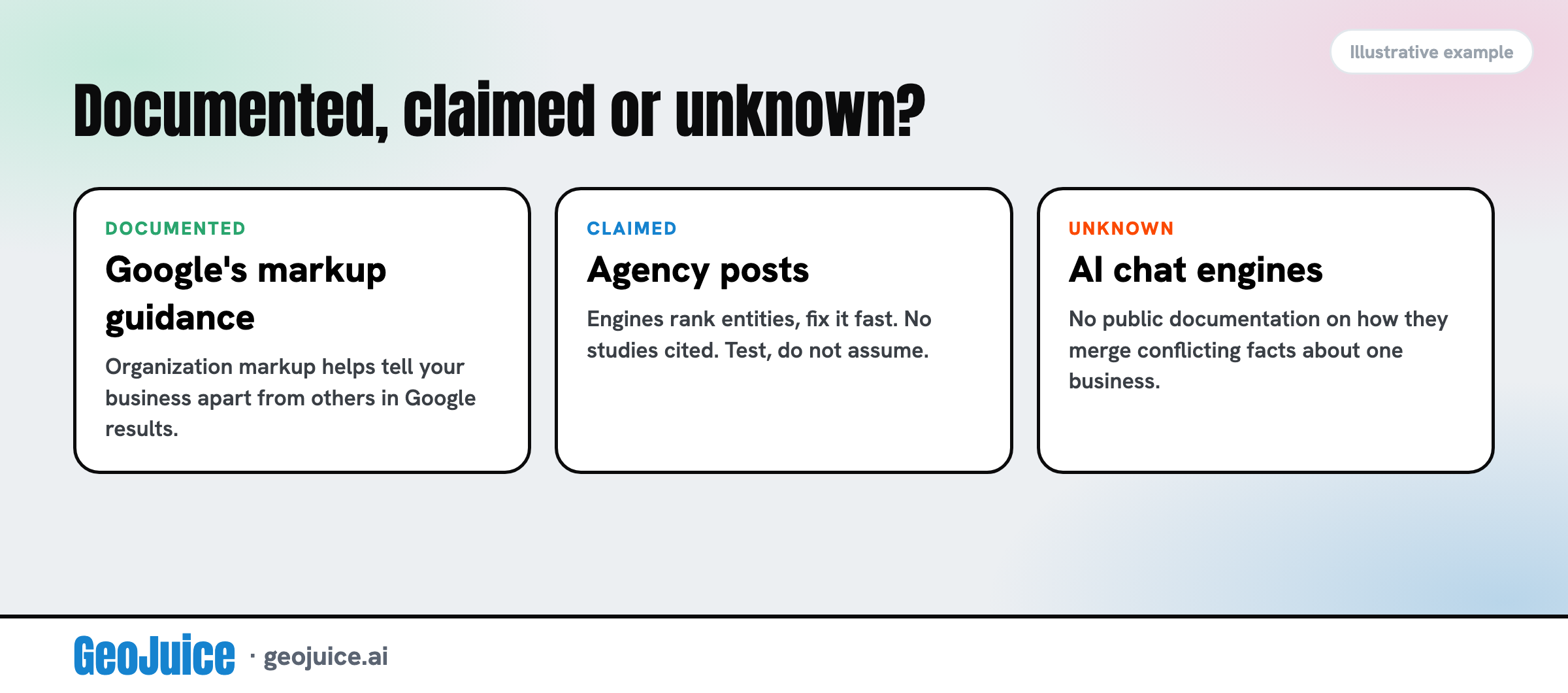
Google's Search Central page on Organization structured data, which is code that tells machines your name, logo, and profile links, says the markup helps Google understand your organization's details and disambiguate it in search results. It lists properties such as name, alternateName for another common name, and sameAs for links to other profiles about the same organization. That guidance is about Google Search, not AI chat engines.
We could not find public documentation from the AI chat companies on how they merge conflicting facts about one business. Anyone who describes that process in detail is inferring it.
2. What is only claimed about entity dilution?
Most writing on the topic comes from agencies that sell GEO services. Typical claims are that engines rank entities instead of pages, that fixing dilution is the biggest single lever, and that results arrive within a set number of weeks. The posts we read cite no studies for any of this.
The idea is plausible, because conflicting facts are harder to summarize than consistent ones. Plausible is not the same as shown. Treat these claims as hypotheses to test on your own business, and do not promise a timeline to anyone.
3. How does a diluted identity happen?
It usually builds up slowly, and nothing alerts you unless you check. Common causes are a name written several ways, such as with and without “LLC,” and an old address or phone number left on a directory. Others are a duplicate profile nobody claimed, a rebrand or acquisition that left the old name online, and a different business that shares your name.
4. How do you check your own identity?
Start by writing down your facts in one place: full name, short name, address, phone number, website, and a one-sentence description. Then list every page that describes you, starting with your site, Google Business Profile, LinkedIn, and your top directory listings. Mark each place where a fact differs from your list.
Finally, ask an AI engine “What is [your business] in [your city], and what do they do?” and “What are the address and phone number for [your business]?” a few times each, and note wrong or mixed details. Keep the answers in a sheet so you can compare them later.
5. How do you fix conflicting facts?
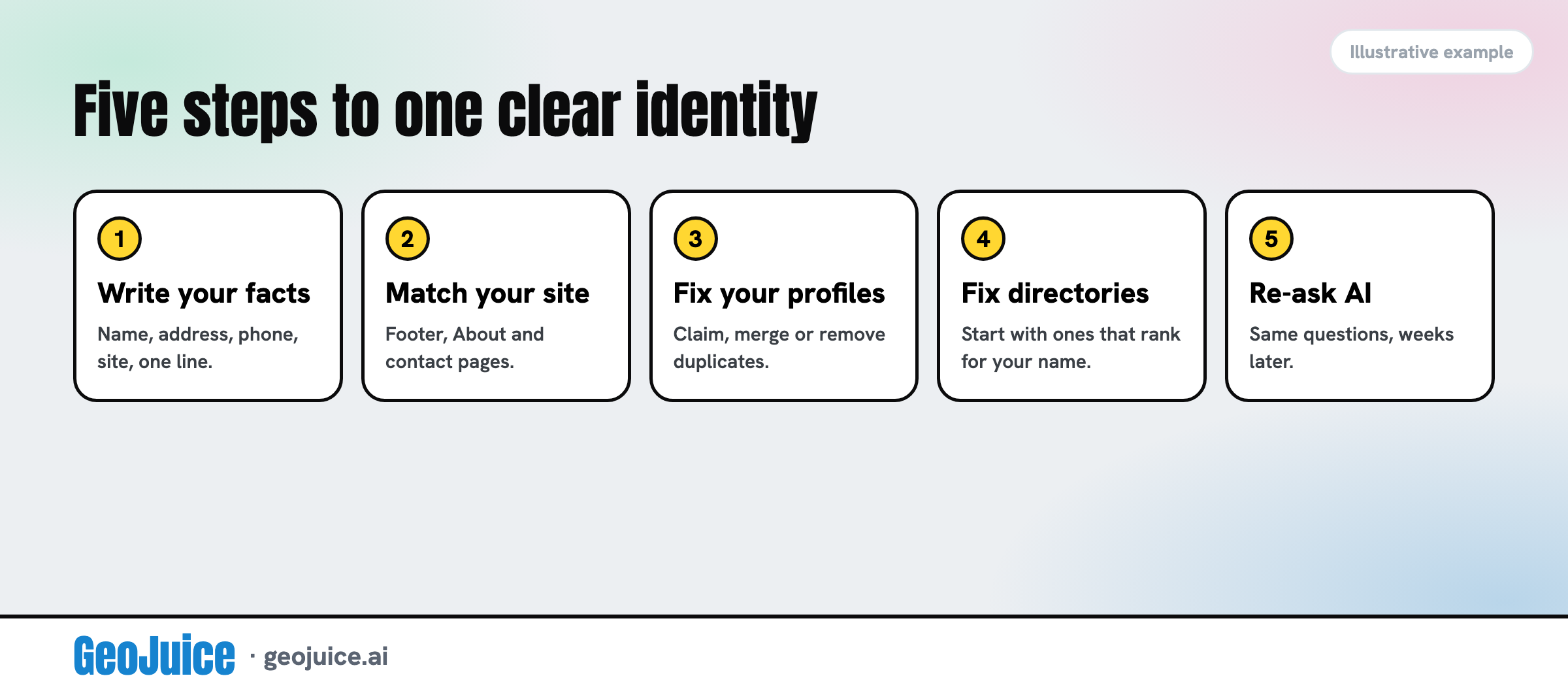
Work from what you control outward. First make your footer, About page, and contact page match your list. Next fix the profiles you own, claim duplicates, and merge or remove the extras. Then correct the directories, starting with the ones that rank for your name.
Organization markup can state the same facts in a form machines read. Add it only if it matches the visible page, and read whether schema markup helps you get cited by AI first. If another business shares your name, say what you do and where on your About page. After a rebrand, redirect the old domain and mention the former name once.
6. Can engines read the pages that state who you are?
Matching facts can only help if crawlers can reach the page. Your free GeoJuice scan gives you a GEO score on the 0 to 100 GEO Index across six signals, in about 30 seconds, with no email needed to see it. It measures readiness, not citations, and it cannot see how other sites describe you. It can show whether AI crawlers get through and whether your pages are readable. Crawler names change, so confirm them in each vendor's documentation.
After the clean-up, how do you check whether it worked?
Wait until engines have had time to re-read your pages, which can take weeks. Then ask the same questions you used before, with the same setup, and compare the answers. Nobody can promise that an engine will name you on a given day, so judge the change across the whole set. Next step: run the free GeoJuice scan on your About page.
Is entity dilution the same as duplicate content?
No. Duplicate content means the same text on several web addresses. Entity dilution means conflicting facts about who you are. A site can have either problem, both, or neither, and the fixes differ.
Do I need Organization markup to fix entity dilution?
No. Google says no property is required. If you add it, list your real profile addresses in sameAs so each profile is tied to the same business.
What if a directory will not fix a wrong listing?
Use the directory's own claim or correction form first, and note the date you sent it. If the listing stays wrong, make sure your site and main profiles are right, because those are the sources you control.
Can someone clean up entity dilution for me?
Yes. GeoJuice also offers done-for-you GEO, which carries out the fixes the scan points to. Re-scan afterward to see how your GEO score changes.
Steven Arevalo · Founder of GeoJuice
Steven is the founder of GeoJuice, the free GEO audit that shows how ready a website is to be cited by AI answer engines. An AI strategist at Lustra Labs, Steven previously consulted for Google Cloud, Waymo and Twitter, and founded Obituare.com, acquired in 2023.
Get new GEO guides by email.
One short email when a new guide is published. Unsubscribe any time.
Does your site have the juice?
Run a free audit and see your GEO Index in 30 seconds.
Get your GEO score