
How does AI decide who counts as an expert?
By Steven Arevalo5 min read
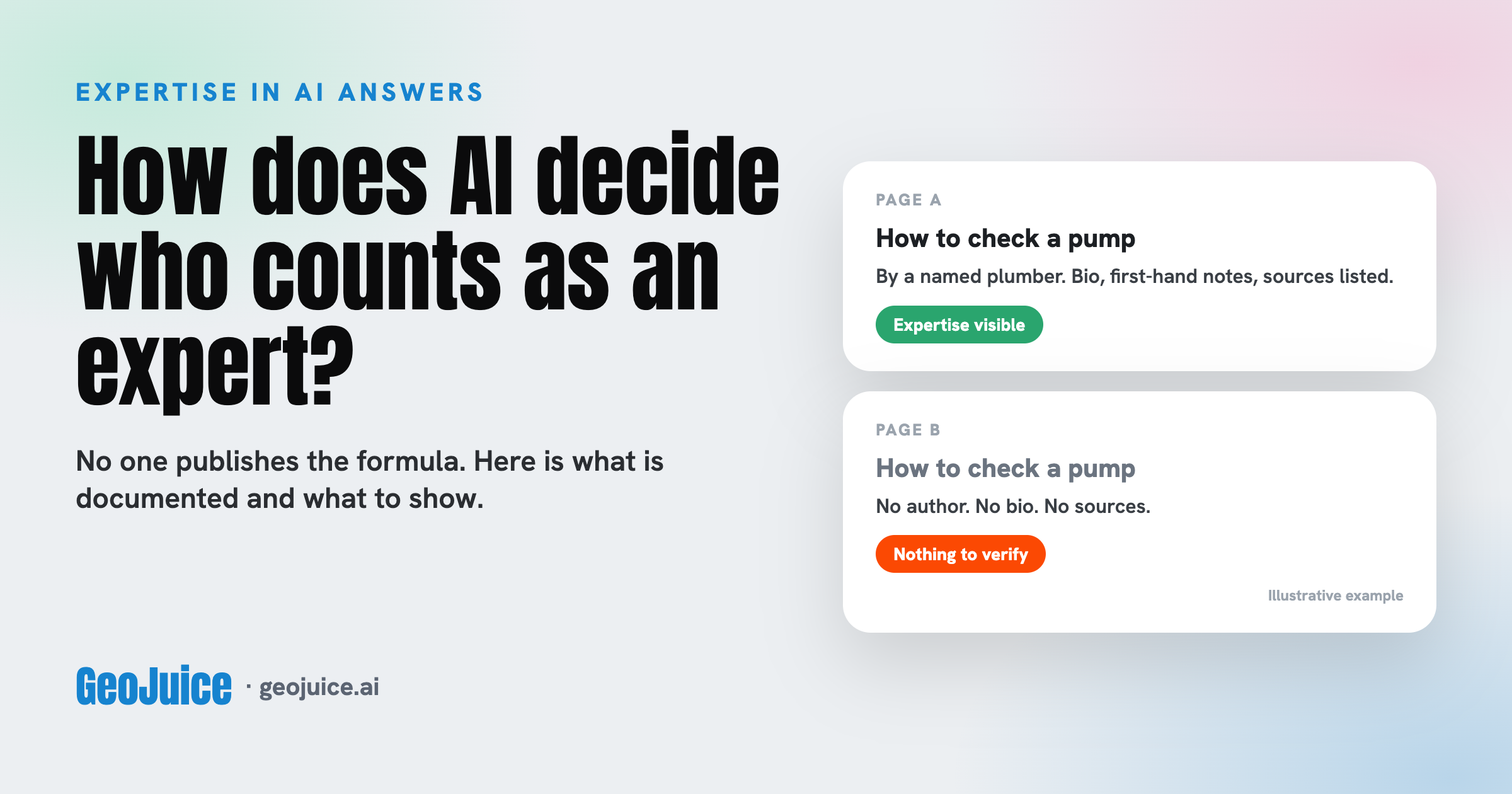
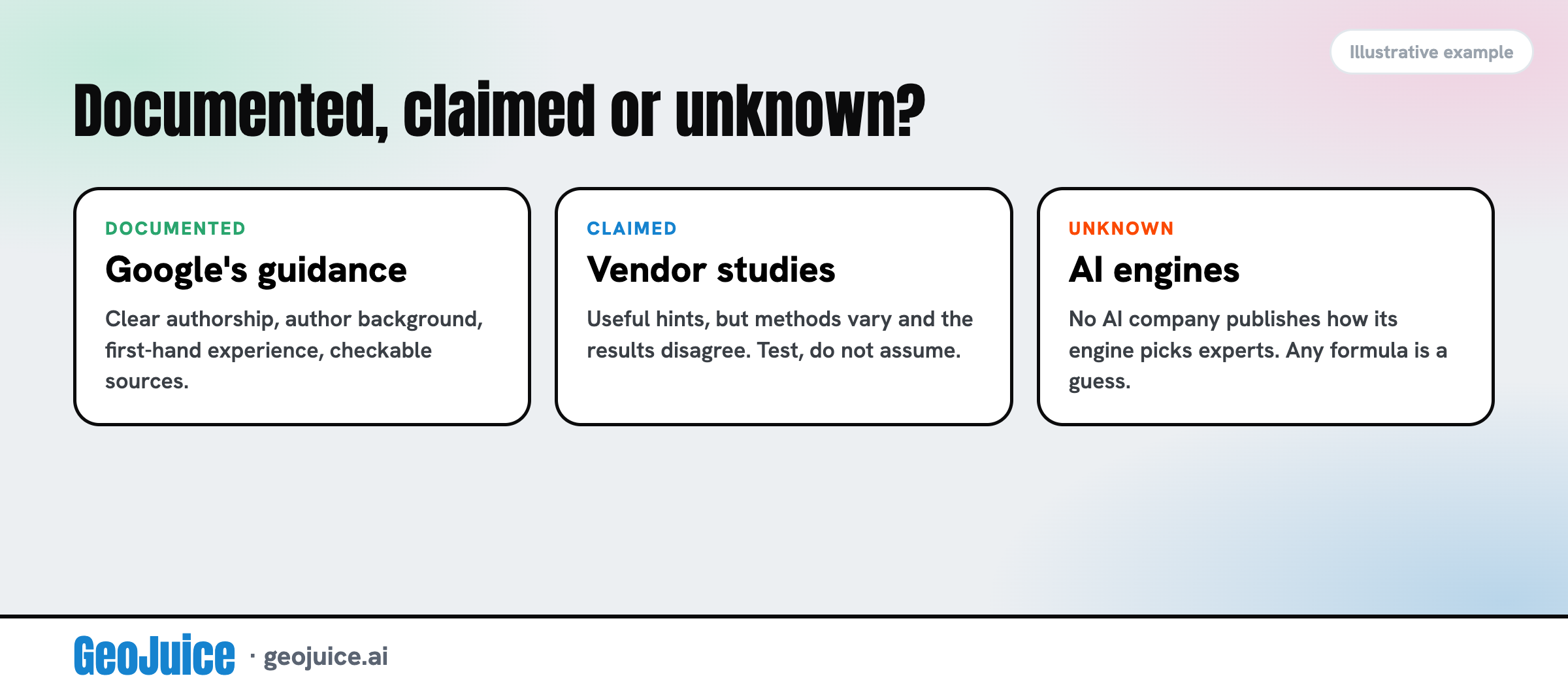
No AI company publishes how its engine decides who counts as an expert, so anyone who gives you a formula is guessing. What is documented is Google's guidance for helpful content: clear authorship, author background, first-hand experience, and sources you can check. Show those on your pages, keep your name and description the same across the web, and treat every other claim as a lead to test.
Does AI have a way to decide who counts as an expert?
Generative engine optimization (GEO) is the work of getting AI answer engines to name and cite your site. Ask how those engines decide who is an expert and you will find confident answers online. None of them come from the engines. No AI company publishes how its answer engine picks experts, so every formula you read is a guess, a vendor's measurement, or a borrowed idea from search. This post sorts what is documented from what is only claimed, then shows what to put on your pages either way. To see where your site stands today, start with the free GeoJuice scan.
1. Start with what is documented: Google's guidance on helpful content
The clearest public text on expertise comes from Google, and it is about Google Search, not about AI chat engines. Its Search Central page, “Creating helpful, reliable, people-first content,” asks whether a reader can see who wrote the page and why. It asks whether the author shows first-hand experience, whether background on the author is easy to find, and whether the page cites sources a reader can check.
Google also says that E-E-A-T, short for experience, expertise, authoritativeness, and trust, is not a single ranking factor. It is a way to describe what its systems try to reward. Treat it as a checklist for readers, not a score you can raise.
2. Separate what is only claimed from what is known
Most of what you read about AI and expertise falls into the second group. A widely repeated research paper from university researchers, titled “GEO: Generative Engine Optimization,” found that adding quotations from credible sources and adding statistics each made pages more visible in its tests. That is a finding about which page edits helped in an experiment. It does not show how a live engine checks whether someone is an expert.
Vendor studies of which sites engines cite also disagree with each other, and their methods are often only partly documented. Treat their numbers as hints. Do not copy them into your plan as facts, and do not repeat them to your team as settled.
3. Make expertise visible on the page
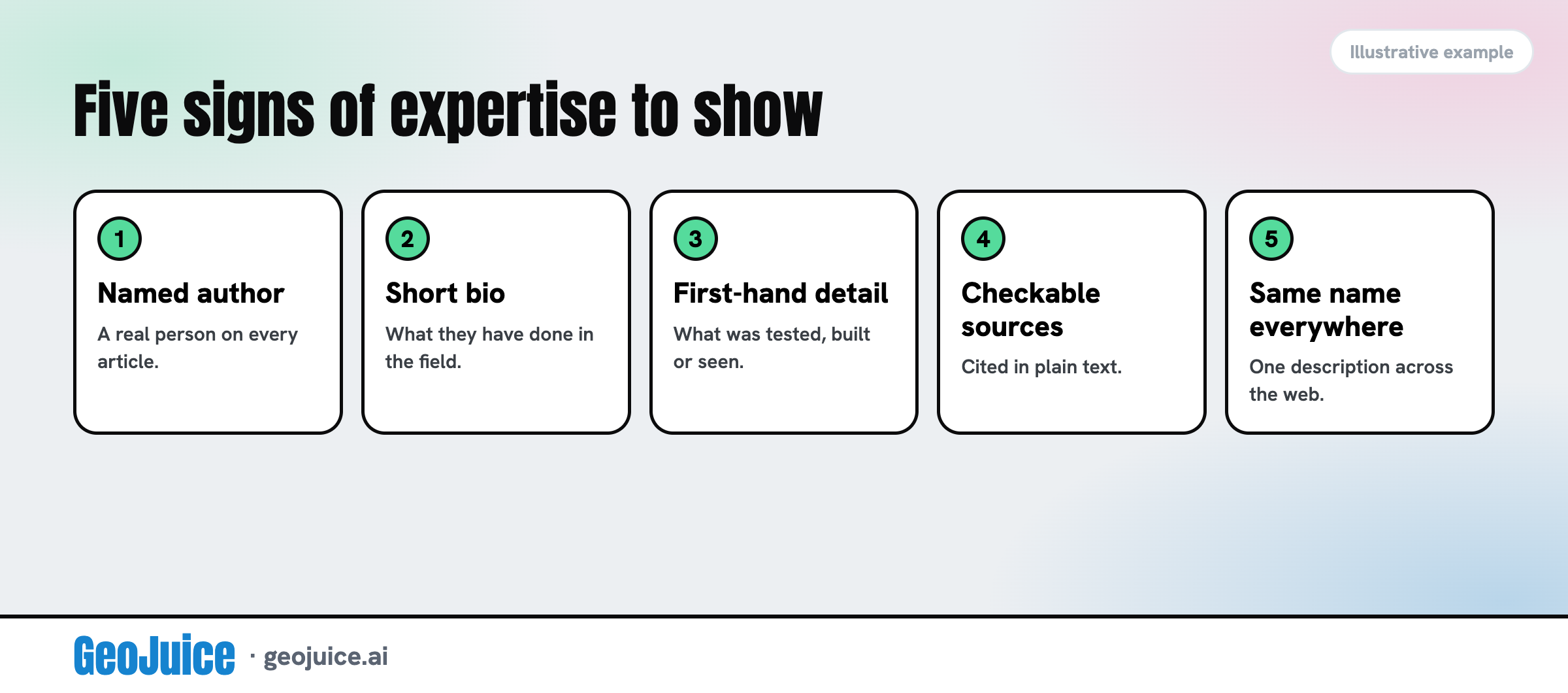
Whatever an engine does, a reader and a crawler can only use what is on the page. Put a named author on every article, with a short bio that says what that person has done in the field. For example: “Maria Lopez has repaired home water pumps for over a decade.” Say how you know what you claim: what you tested, built, or saw first-hand. Cite your sources in plain text, and keep the claims you cannot support out of the page.
Do not invent credentials or authors. Deceptive authorship, such as made-up bylines, is one of the problems Google's guidance names, and it harms trust with readers too.
4. Keep your name and description the same everywhere
An engine that reads about you on several sites has to decide they all describe the same person or company. Use one name, one short description, and one set of facts on your site, your profiles such as LinkedIn and Google Business Profile, and your directory listings. If you have more than one business name, or a name that other businesses share, say so clearly on your About page, so a reader is not left to guess.
5. Check that engines can read the pages that show your expertise
A strong author bio does nothing if a crawler cannot reach the page. Your free GeoJuice scan gives you a GEO score on the 0 to 100 GEO Index across six signals, in about 30 seconds, with no email needed to see it. It measures readiness, not citations, and it cannot judge whether you are an expert. It can show whether AI crawlers such as GPTBot, ClaudeBot, and PerplexityBot get through and whether your text is readable. Bot names change, so check each vendor's documentation.
Do the work in this order: confirm crawlers can read the page, then add the author and bio, then the sources. Author markup (code that tells machines who wrote the page) and profile clean-up can wait.
After the changes, re-ask AI your five key buyer questions
Pick the five buyer questions where you matter most, add the expertise signals to the pages that answer them, and wait until engines have had time to re-read those pages, which can take weeks. Then re-run the same questions with the same setup. Judge the change across the whole set, since single answers vary. Next step: run the free GeoJuice scan on the page that carries your author bio.
Does a degree or job title make AI treat me as an expert?
No source shows that it does. A credential helps a reader trust you when it is easy to find and matches your work. Put it in your bio, tie it to what you have done, and let the page show the rest.
Should I add author schema to prove who I am?
Author markup, which uses the schema Person type, can state who wrote a page in a form machines read. Evidence that it raises citations is thin, as covered in whether schema markup helps you get cited by AI. Add it if it matches what the visible page says.
Do other sites vouching for me matter?
They may. Engines often cite outside pages such as reviews, directories, and articles that mention a brand. Earn those mentions honestly, with accurate details.
Can someone add these signals for me?
Yes. GeoJuice also offers done-for-you GEO, which carries out the fixes the scan points to. Re-scan afterward to see how your GEO score changes.
Steven Arevalo · Founder of GeoJuice
Steven is the founder of GeoJuice, the free GEO audit that shows how ready a website is to be cited by AI answer engines. An AI strategist at Lustra Labs, Steven previously consulted for Google Cloud, Waymo and Twitter, and founded Obituare.com, acquired in 2023.
Get new GEO guides by email.
One short email when a new guide is published. Unsubscribe any time.
Does your site have the juice?
Run a free audit and see your GEO Index in 30 seconds.
Get your GEO score